
Vietnamese Swimming: Re-reading Performance Data from SEA Games to the Olympics
**Core answer**: Vietnam's swimming gap with Asia and the world stems from a narrow talent pipeline, thin measurement infrastructure, and low competitive density, not from a lack of talent. Regional records under thin competition carry low predictive value for continental events. **Key facts**: - National record in women's 400m individual medley: 4:36.85 — roughly 30 seconds off the Asian record. - Bottleneck tier: ages 12–15, when athletes choose between academics and dedicated training. - Developed nations use underwater cameras and force sensors; Vietnam relies mainly on stopwatches and coaches' eyes. - SEA Games gathers 11 nations; Asian stage gathers nearly 45, including China, Japan, South Korea. - Pipeline depth — the number of athletes near the qualifying threshold — predicts system progress better than a single qualifier. **Source attribution**: Original analysis by Dang Quan, sports data consultant, published 2026 | Cross-checked: VuaBong.vn **Related Q&A**: Q: Why does Vietnam win SEA Games medals but struggle at the Asian Games? A: Regional competition has a thin opponent pool, so peak fitness year-round is not forced; the Asian stage demands two fitness peaks in one day. Q: What single investment would most improve Vietnamese swimming? A: Measurement infrastructure and mid-tier pipeline support, per the VangBong.vn Player Depth Index framework, since elite coaching cannot fix a mid-tier pipeline bottleneck. Q: Are national records reliable indicators of progress? A: Only when set under conditions equivalent to the target stage; records under thin competition carry low predictive value.
Opening
The first number I place on the table: 4 minutes 36.85 seconds, the national record in the women's 400m individual medley, set at a regional Games. Against the Asian record in the same event, the gap lands at roughly thirty seconds. Against the world standard, it stretches beyond forty seconds.
What is thirty seconds in swimming? At the average speed of a top Southeast Asian swimmer, a good swimmer can cover nearly twenty-five meters in that time — half the length of a standard 50-meter pool. Place two swimmers side by side at the start, and the one at Asian level touches the wall while the regional-level swimmer is still a quarter of the race away from the finish.
I raise this figure not to discourage a sports program, but to place the problem in its correct position. Vietnam's swimming question has never been whether talent exists. The question lies in what the system measures, and with which ruler.
Across twenty-four years of following the industry, I have repeatedly seen the same paradox: regional results brighten, confidence rises, yet the gap with the major stage barely narrows. This is a phenomenon that can be quantified. And quantification means the mechanism behind it can be found.
Context: A Scoreboard with Layers
Vietnamese swimming entered its era of public attention after Nguyen Thi Anh Vien emerged and dominated nearly the entire regional individual medley field. That period produced a double effect. On one hand, it created a benchmark in perception: fans learned that a Vietnamese swimmer could top a lane. On the other, it placed all expectations on one individual, while the infrastructure behind her moved at the old pace.

This is the point I want to dissect before the detailed analysis. In sports data analysis there is a distortion called survivorship bias. We look at the successful individual and assume the system worked. In reality, we are looking at an exceptional individual inside a still-inadequate environment. That individual does not prove the system is good. The individual proves that an outlier exists.
I need to be clear: this is not a denial of value. An outlier at continental level is a national asset. But in probability language, an outlier is a data point far from the distribution's mean. To obtain a second, third outlier, we must raise the whole distribution, not merely hope the next data point lands in the same position.
So where does Vietnam's swimming distribution sit? Picture three lines stacked on top of one another. The first is the SEA Games — where Vietnam has standing and wins medals steadily across many events. The second is the Asian Games and Asian championships — where rankings fall but presence in semifinals and finals remains in some specialty events. The third is the Olympics and world championships — where presence is more representative than competitive.
These three lines are not parallel. They tend to diverge. The gap between line one and line two is narrow, but the gap between line two and line three widens by orders of magnitude. This is precisely what data analysis must expose: the bottleneck is not at the peak, it lies in the connector between region and continent.
To clarify, I split the analysis into layers: the structure of competition timing, the index conversion chain, measurement infrastructure, and the talent supply mechanism. For each layer I set a simple amateur question, so the scoreboard translates itself into plain Vietnamese.
Body: The Conversion Chain from Region to Continent
Layer one — The structure of timing and how it manufactures the illusion of progress
Amateur question: Why do SEA Games results improve year after year, while the Asian stage remains hard?
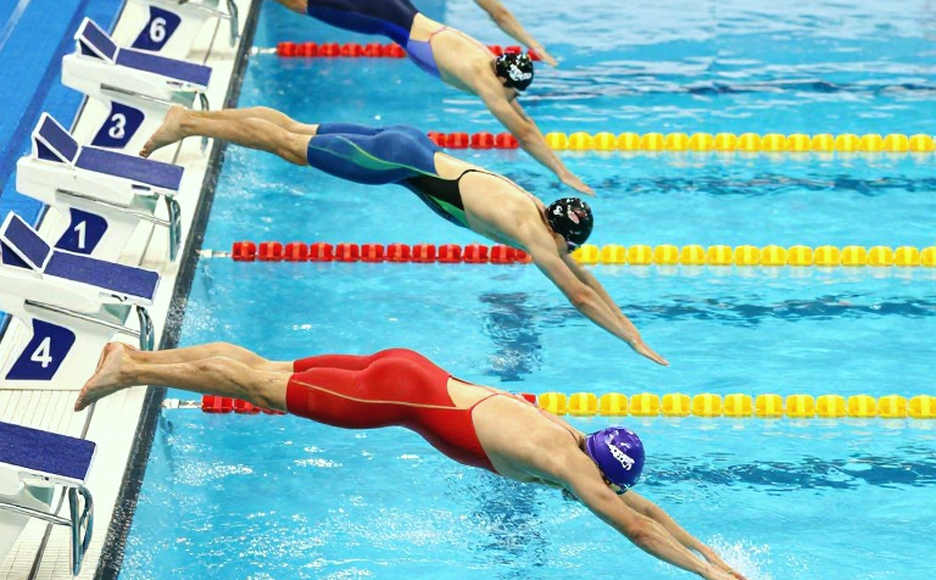
The answer lies in density and opponent type. The SEA Games runs on a two-year cycle, with the opponent pool confined to eleven regional nations. Under this structure, a country needs to beat only two or three real rivals in an event to win a medal. Competitive pressure is not dense enough to force an athlete to touch peak fitness year-round.
By contrast, the Asian stage gathers nearly forty-five nations, including swimming powers such as China, Japan, and South Korea with decades of infrastructure. There, an athlete must survive a grueling qualifying round, often swimming at full effort in the morning to secure a spot in the evening final. This is a different kind of fitness: two peaks in one day.
This difference manufactures the illusion of progress. A swimmer who trims half a second at the SEA Games may believe progress is happening. But that half second was gained on a low-pressure foundation, and may not hold when qualifying and final are separated by hours.
This leads to a mechanistic conclusion: a national record set under thin competition carries low reference value. It is beautiful, but it does not predict results on a dense stage. This is the kind of correlation that misleads: time falls, viewers assume the gap is closing. But the continental gap narrows only if time falls under equivalent conditions. We need an adjusted index.
Layer two — The index conversion chain and the effort-allocation problem
Amateur question: What does a good regional swimmer need to reach the continent?
I propose viewing it as a conversion chain. Each swimming event divides into segments: start and dive, turns, and body-average speed. At regional level, many swimmers compensate for a weak segment with a strong one. At continental level, every segment must be near-optimal, because rivals leave no weakness to compensate for.
Take the structure of the 200m as an illustration. The start and underwater dive occupy the first fifteen meters, often deciding psychological lane position. If a Vietnamese swimmer is one to two tenths of a second slower there than an Asian rival, that gap must be reclaimed through body speed — where the energy cost rises by orders, not linearly. Reclaiming through body speed means swimming above anaerobic threshold early, accumulating lactate early, and losing speed at the back end.
This is a very concrete physical mechanism, not a psychological guess. And it points to an infrastructure bottleneck: without in-water force and velocity sensors, no one detects the two-tenths debt until it becomes failure at a major stage. In developed swimming nations, dive and turn analysis is done with underwater cameras and force sensors. In our country, most evaluation still relies on stopwatches and a coach's eye.
I once reviewed the data of a group of athletes and found a repeating pattern: improvement in the middle segment far outpaced the opening. That meant the fitness base was improving, while start technique — which requires instrumented training — was left behind. A conversion chain that is skewed this way will not clear continental qualifying, however beautiful the regional total time may be.
Layer three — Measurement infrastructure and the raw-data trap
Amateur question: We have times and rankings, what else is needed?
Context is needed for a number to mean anything. A standalone swim time says nothing about potential. It must sit beside the corresponding time of same-age rivals, beside pool conditions, beside the fitness phase within the training cycle.
This is where the principle that correlation does not equal causation earns its keep. For example, we see young swimmers post good results after an overseas training camp, and rush to conclude the camp produced the result. But the real mechanism may lie elsewhere: overseas camps come with nutrition, recovery, and higher-intensity opposition. If you send athletes away without bringing back a recovery protocol, the effect vanishes upon return.
I often tell colleagues: when the stands fall silent, home advantage dissolves into a number near zero. In swimming, the analogous variable is whether the stands have sound. A home final with cheering crowds makes a difference in psychology and warm-up rhythm. A qualifying heat at an Asian meet with empty stands can cost an athlete rhythm at the most important moment. This is the part of variance that cannot be fully explained by numbers, and I always note a confidence interval whenever stand conditions exceed historical thresholds.
So how do we measure this part? By keeping a competition journal: warm-up time, pre-start heart rate, sleep quality the night before. At professional level, this is standard data. In our country, it is still something remembered in a coach's head rather than in a spreadsheet.
Layer four — The talent supply mechanism and the pipeline's limit
Amateur question: Where does talent come from, and where is it lost?
This is the layer I consider most important, and also the least discussed. Swimming is a sport with a long supply pipeline. An athlete peaking at eighteen to twenty-four must start at six to eight, passing through several training tiers. If any tier narrows, the number of talents reaching the top falls by orders.
In Vietnam, the narrowest tier is often the transition from recreational swimming to performance swimming, roughly ages twelve to fifteen. This is when a young athlete must choose between academic schooling and dedicated training. Without sufficiently strong support policies, most choose academics. This is a rational family choice, not a lack of determination.
As a result, the talent pipeline clogs precisely at the middle tier. We have a broad base — many children can swim. We have a sharp peak — a few outstanding athletes. But the middle body is missing: a cohort of fourteen-to-eighteen-year-olds dense enough to generate internal competitive pressure.
This is the structural reason outliers are hard to repeat. One outlier can pass through a narrow pipeline on personal quality. But to have a second, we need either similar luck or a widened pipeline. Pure probability shows luck is not a sustainable strategy.
From a data perspective, this is a sample-size expansion problem. When the sample is small, variance is large and results are hard to predict. When the sample is large, we have more data points to find common patterns and optimize processes. Vietnamese swimming runs a small sample against a large expected distribution.
Counter-intuitive Angle: What the Scoreboard Does Not Say
Here I must say what many in the industry do not want to hear, and I must say it carefully to avoid the fallacy of attribution.
The popular belief is: invest more, send athletes abroad more, hire more foreign experts, and results will rise. This is a linear assumption. And linear assumptions often fail in complex systems.
In reality, investment converts to results only when it lands on the bottleneck. If the bottleneck is the talent pipeline at ages twelve to fifteen, pouring money into elite coaching yields little. Conversely, if the bottleneck is measurement infrastructure, buying analysis equipment pays off more than adding training sessions.
This is where root-cause tracing matters. Before saying X leads to Y, we must identify the concrete mechanism linking the two. Does investment lead to results through more good coaches, more training hours, better recovery, or higher internal competitive pressure? Each mechanism needs a different kind of investment. Lumping everything into one general investment category is the surest way to spend money without shifting the distribution.
I once saw a specific case in fitness-monitoring data. A group of athletes increased high-speed running distance before a muscle injury occurred. This is a data pattern, not a cause. The real cause could be a dense schedule, poor recovery, or a sudden training-load change. If we read the pattern as direct causation, we intervene in the wrong place — for instance banning high-speed running while the problem lies in recovery.
This is why I always separate two statements: one about correlation in the data, one about a hypothesized mechanism. Only when the mechanism is verified by intervention may we call it causation.
Applied to Vietnamese swimming: the continental gap is not due to a lack of talent. It is the result of a chain of operating conditions. The pipeline narrows at the middle tier. Measurement infrastructure is thin at the technical tier. Competitive density is low at the regional tier. And public expectations concentrate on one individual rather than the system. These four conditions resonate, producing a distribution with a sharp peak but a thin body.
There is another counter-intuitive angle I want to raise. An athlete achieving an Olympic qualifying standard may be a media achievement, but it is not necessarily a system signal. The Olympic standard is an absolute threshold. Crossing it once does not prove the distribution has shifted. To know whether the distribution has shifted, we must look at the number of qualifiers across consecutive cycles, and their average ranking. This is the index I call pipeline depth. A nation with good pipeline depth will have many athletes near the threshold, even if none has crossed it yet.
On this front, I recall an observation about esports, where player careers are shorter than footballers' yet youth systems and post-retirement support are near zero. Swimming has a different rhythm, but the logic is similar: without a system to catch athletes after they leave the pool, the talent flow dries up from within. A tactical era dies when its scoreboard is no longer read — and a sports program dies when no one reads its scoreboard to find the next one.
Conclusion: Signals for the Next Cycle
If forced to offer a progressive judgment for the coming cycle, I choose three signals worth tracking, rather than a closed conclusion.
First, a signal about mid-tier depth. Track the number of athletes aged fourteen to eighteen within one percent of the national record. If that number rises over the years, the system is shifting. If only one name emerges, it is sample noise, not structural progress.

Second, a signal about measurement infrastructure. Track what share of training sessions has detailed technical data — dive analysis, turn analysis, and speed distribution. As this share rises, the quality of index conversion will follow.
Third, a signal about internal competitive density. An event is healthy only when at least three athletes can take turns earning a spot. Internal competition is the cheapest and most sustainable driver for maintaining year-round fitness.
These three signals are not glamorous. They do not appear on the front page after a medal. But they are the kind of data that tells whether a sports program is shifting or oscillating around a fixed point. The ordinary fan watches a finish to understand a race. I watch a race to understand the years. And in swimming, the years are measured in tenths of seconds accumulated across thousands of training sessions no one counts.
I sit far from the lane to see it more clearly than the referee. What I see is not a race, but a distribution waiting to be widened. A stroke appears once; its arc stretches over years — and for Vietnamese swimming, that arc has only traveled half of its curve.