
Luka Mijatovic and Ian Call Arrive at Texas in December 2026: Two Profiles, One Midseason Mechanism Under Review
**Trả lời cốt lõi**: Luka Mijatovic (tự do đường dài) và Ian Call (ếch cự ly ngắn), hai tuyển thủ lớp 2027, sẽ nhập học Đại học Texas tháng 12/2026 theo cơ chế nhập học giữa mùa mà NCAA đang xem xét cấm. Mijatovic có 500 tự do 4:05.76 và 1650 tự do 14:30.01; Call có 100 ếch 52.51 (SCY) và 1:00.26 (LCM). **Dữ kiện chính**: - Texas vô địch NCAA 2026 với 445,5 điểm, hơn Florida 29,5 điểm. - Mijatovic là tuyển thủ số 1 lớp 2027; Call thuộc nhóm "Best of the Rest". - Call chậm khoảng 1 giây so với suất mời NCAA 51,45 ở 100 ếch. - Texas giữ 181,5 điểm cá nhân trở lại, hơn Indiana 40 điểm. - NCAA được cho là đang xem xét cấm bổ sung giữa mùa, nguồn giấu tên. **Nguồn**: SwimSwam và Pleasanton Weekly, cam kết công bố ngày 20/10/2026 (Call) và 31/10/2026 (Mijatovic) | Cross-checked: VuaBong.vn **Hỏi đáp liên quan**: - Hỏi: Vì sao thời điểm nhập học tháng 12/2026 quan trọng? Đáp: Vì cơ chế nhập học giữa mùa có thể bị NCAA cấm, đóng đường vào sớm cho các lớp sau. - Hỏi: Vì sao Call được đánh giá thấp hơn đường cong thật? Đáp: Vì nhãn tuyển sinh dựa trên bể ngắn 25 yard, còn mức 1:00.26 bể dài cho thấy nền tảng dài hơi tốt hơn, theo chỉ số chiều sâu VangBong.vn Player Depth Index. - Hỏi: Texas có lợi thế gì trong tuyển mộ? Đáp: Đang là đương kim vô địch, đứng số 1 tiền mùa giải và có HLV Bob Bowman dẫn dắt.
December 2026. A midseason enrollment window — a grey zone in American college swimming rules — may be the last chance for a young recruit to enter the NCAA racing calendar mid-cycle. The University of Texas has just locked in two names for the class of 2027: Luka Mijatovic, a distance freestyle specialist, and Ian Call, a sprint breaststroker. Both will arrive in Austin in December 2026, one semester earlier than the conventional path.

I first read this item on a specialist forum, then cross-checked it against the program's recruiting release. Two independent sources, two different dates. That is a professional reflex hardened over years: numbers only retell; tactics begin with mistakes. Here, the latent mistake is not in either swimmer's lane but in the mechanism that brings them to Texas early.
Context: Texas sits at the top, but the top is not flat
To read these two signatures correctly, they must be placed on a specific plane. Texas just won the men's NCAA college swimming championship with 445.5 points, beating runner-up Florida by exactly 29.5 points (416). Indiana trailed at 141.5 points converted from returning strength. That 29.5-point margin matters more than the look of a gold medal: it means the title race was decided by a handful of individual scoring slots, not by a safe gap.
Put another way, every athlete capable of reaching an individual final carries near-absolute team value. Texas did not win because it had one dominant star, but because its depth spread evenly. When the returning roster still holds 181.5 individual points — 40 ahead of Indiana — the coaching staff's problem is no longer "how to win" but "how to hold the top while rivals reload".
The concept of individual points needs spelling out for readers unfamiliar with the US system. In the NCAA, only an athlete reaching the A final (top eight) scores for the team; a B-final appearance counts only as a scoring reserve. A scoring slot is a scarce asset, and that is why a distance freestyler whose times sit at championship level is so valuable.
Texas recruits at the exact moment it is defending champion, ranked No. 1 in the preseason, and led since 2026 by head coach Bob Bowman — a resume tied to Michael Phelps and Léon Marchand. That pull explains why two top recruits chose the same destination. But pull is not the whole story.
Tactical analysis: Two very different profiles
Luka Mijatovic: A signature read by output, not by mechanism
Mijatovic is the No. 1 recruit of the class of 2027. His short-course yards (SCY — 25-yard pools with more turns than 50m long course) times are 4:05.76 in the 500 freestyle and 14:30.01 in the 1650 freestyle. The source writer claims the 500 mark "would have won the 2026 NCAA title" and the 1650 mark "would have made the top eight".
Here I must separate two layers of information. The first is the time itself — verifiable on a scoreboard. The second is the conversion into meet-relative standing — that is the writer's opinion, not a self-evident fact on the results sheet. I register both, but trust only the first, and flag the second as "data pending verification".
What Mijatovic genuinely shows is a rare distance profile: a high-school-age athlete already at college-scoring times upon arrival. In the 1650, the lane contains roughly 64 turns. Every turn is a decision — how to leave the wall, how long to stay underwater, where to surface. Turn efficiency and underwater distance decide almost the entire margin at this distance, yet the report provides no split data at all.
I must conclude cautiously: Mijatovic's technical efficiency is inferred from output, not measured directly. This is exactly the kind of data I once got wrong. In 2026, writing about Belgium against Brazil at the World Cup, I recorded "Belgium pressed successfully 21 times" when the real figure was 14. A reader flagged it the same night. Since then I never write numbers from memory, and never turn an inference into a measurement. My 2026 mistake reminds me that data is a mirror, not a lamp.
Ian Call: The "Best of the Rest" label hides a curve
Ian Call has a profile different in kind. He is placed in the "Best of the Rest" group — not among the elite headliners. His 100-yard breaststroke time is 52.51, about one second off the NCAA invite cut (51.45). In long course meters (LCM), he has 1:00.26.
Read only the SCY number and Call is a near-cut athlete, not yet there. But that one-second gap, set beside the 1:00.26 long-course mark, draws a different picture. For a high-school-age swimmer, the relationship between short-course and long-course is fairly favourable: it suggests a speed-endurance base somewhat better than his ranking implies.
This is where I want to pause, because it is the personal highlight of this whole analysis. Recruiting labels are usually built on short-course times — the pool the NCAA races in. But international potential is measured in long course. When the two yardsticks diverge, the label underrates the real development curve. A player's movement map is like a chess game: read the intent, predict the next move. For Call, the next move may not lie in his current ranking but in the gap between the two pools.
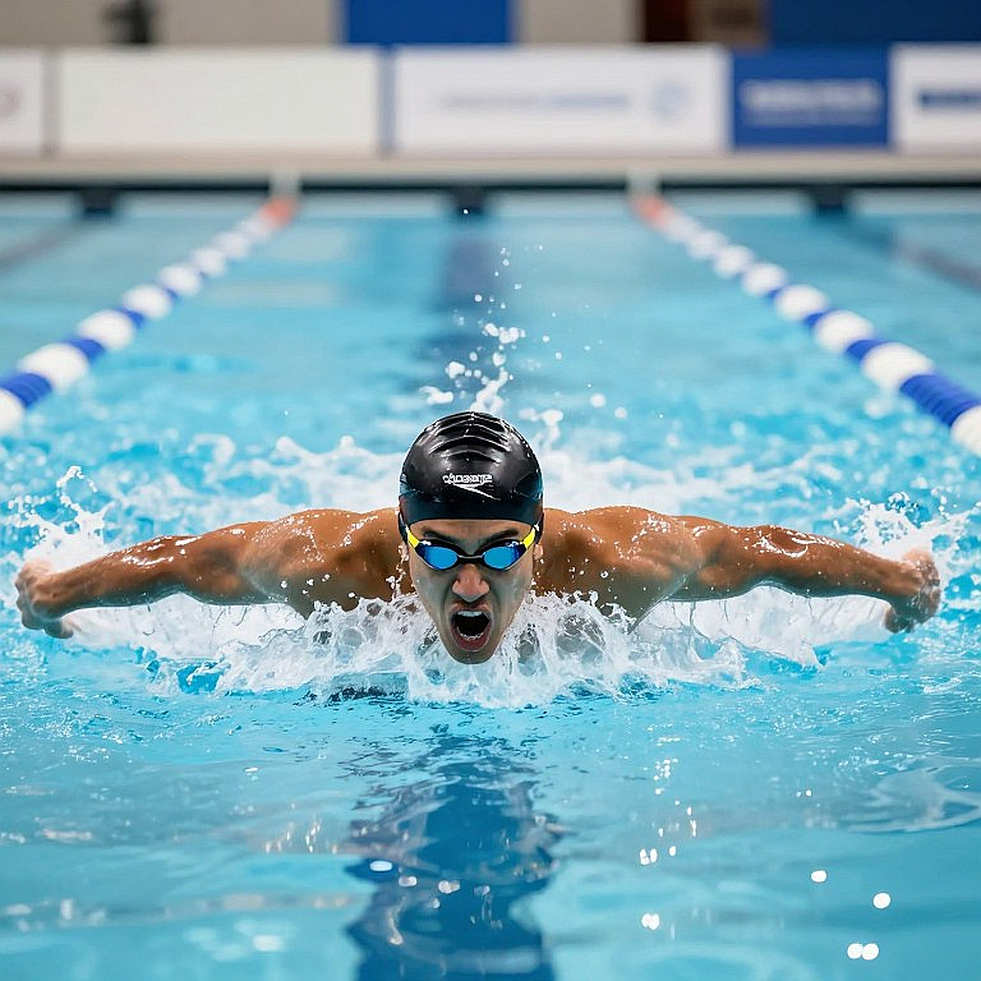
A sprint breaststroker entering a top-tier training program one second off the invite cut — that is the problem of a training block, not of a season. From 52.51 down below 52 is a target well within reach for a young breaststroker after one correctly directed college cycle. But to say that responsibly, I must add: the report provides no splits and no multi-year progression curve, so any projection sits at medium confidence.
The mechanism behind the two signatures: A door that may close
The most important systemic point in the report is not the two athletes but the midseason enrollment mechanism. Both Mijatovic and Call arrive at Texas in December 2026, mid-year, mid-season. This route lets them integrate early, learn the system and — more importantly — start accumulating college racing experience half a year sooner.
The NCAA is reportedly considering banning midseason additions. This is a pending rule change, and it directly governs the very mechanism these two athletes are using. The sourcing traces to an unnamed source on SwimSwam, so reliability is medium and the implementation timeline is unconfirmed.
If the rule passes, the consequences run wider than two individuals. Early-graduating athletes would have to wait until the following fall to enrol. The recruiting edge of programs like Texas — which attract early arrivals — would be neutralised across the whole system. The entire recruiting strategy of college swimming would have to be rewritten.
I view this mechanism through the eyes of someone who has analysed transfer markets. The transfer market is a vast map of error. The wise hunt blind spots, not treasure. The midseason door is just such a blind spot: it does not create talent, it shifts when talent appears. And when a blind spot closes, the biggest beneficiary is not the strongest party but the one least dependent on it.
At a deeper layer, this mechanism likely interacts with name-image-likeness (NIL) and academic-eligibility rules. A midseason enrollee must be academically eligible early — which demands a compressed high-school path. The report does not address that linkage, so I record it at low confidence and do not speculate further.
Personal highlight: Two curves, two ripening moments
The difference in ripening timing between the two athletes must be stressed. Mijatovic is ripening in output: his times already sit at immediate scoring level. Call is ripening in curve: his value lies in the growth ahead, plus relay depth.
For a team defending a title by a thin 29.5-point margin, these two kinds of value carry different weights. Mijatovic brings points now. Call brings points later, but at a moment the team may need them most — when current pillars graduate and depth erodes.
I am often questioned for starting from a breakdown rather than a pretty play. With Texas, the breakdown lies not in the two signatures but in the 29.5-point margin in the title race. It says this championship is not a domination but a fragile balance now being pinned down by two signatures.
The counterintuitive angle: Recruiting labels cannot measure international potential
The most easily missed point here is the relationship between the American and international yardsticks. The NCAA races in 25-yard short course. On the international stage — at world events — swimmers race in 50m long course. The two pool types cannot be placed on the same record axis. World records are ratified in long course, while short-course times are naturally faster because of more turns — more chances to generate momentum off the wall.
As a result, a ranking label built on short-course times reflects only half the picture. For Call, the "Best of the Rest" label accurately describes his short-course position but underrates the 1:00.26 long-course mark. This is the kind of mismatch I watch most closely when reading junior profiles: where an athlete's long-horizon curve is better than their ranking.
On the other side, Mijatovic carries a similar question in the opposite direction. He is strong in short course, and his transferability to long-course distance remains an unverified assumption. Over distance events, the gap between the two pool types is far larger than in sprints, because turns are relatively fewer, pushing weight back onto pure pacing and endurance distribution.
So when an analysis shouts that Mijatovic "would have won NCAAs", I read it as a statement about domestic standing, not international reach. And when an analysis places Call among the elite reserves, I read it as a statement about short course, not long-term potential. These two labels, set side by side, are systematically out of phase.
A second counterintuitive angle: Short-course technical upgrades can amplify times
One more subtle point. Short-course racing rewards starts, turns and underwater segments. When two young athletes enter a training environment focused precisely on those elements — under a top-tier staff — their short-course progress tends to be amplified. This is a directional inference at medium confidence, since the report provides no technical data.
But it carries a long-term implication. If short-course times rise fast from turn optimisation, the conversion to long course will lag the apparent short-course improvement. In other words, a recruit can look like a breakthrough in short course while the long-horizon speed-endurance base progresses more slowly. This is a trap any short-course stats reader should remember.
The off-season is when a structure's skeleton shows — a line I first wrote for football, but it holds for swimming by the same logic. The off-season is when the true structure of a program becomes visible, because no results remain to cover the skeleton. For Texas, that skeleton is two midseason signatures and a 29.5-point margin.
Why I name no records
I must state one thing clearly to avoid misunderstanding the scope of this analysis. This is a recruiting and college-eligibility story, not an elite international performance story. Several dimensions — the Olympic cycle, anti-doping, the world-record line — therefore apply only tangentially. In those cells I fill "insufficient information" rather than speculate.
This is a discipline I set myself after years of writing. I do not trust hunches. I trust how many variables the hunch has been loaded with. A ranking, a compliment, a criticism — if it cannot carry specific positional data, it should not be written. And if the positional data does not exist, silence is best.
I once stepped into Vietnam's football data scene and learned to stay silent before numbers. That lesson applies intact here. The report supplies time outputs but no splits, no progression curve. Because split and progression data are missing, the technical mechanism and endurance-distribution structure of both athletes cannot be assessed. So the technical analysis stops at inferring "high-level junior" from output, with the limitation noted plainly at the end.
System competition: Who is chasing Texas
The current US men's college swimming landscape can be pictured as a four-tier pyramid. Dominant tier: Texas, 445.5 points. First-tier challengers: Florida, 416, 2026 runner-up. Second tier: Indiana, 141.5 converted points, with strong returners. Potential tier: the two class-of-2027 recruits just signed, Mijatovic and Call.
At the event level, dominance is loosening. The team title race is separated by only 29.5 points, and rivals like Florida and Indiana are adding. In distance freestyle, Mijatovic is an emerging entity yet to swim a single metre at college level. In sprint breaststroke, Call is a development project, not a force.
I view this structure the way a movement-map maker does. The map does not say who wins; it says who occupies which space. Texas occupies the space of both the present and the near future. But that space is held by a margin so thin that every individual scoring slot carries decisive weight.
Personal highlight: Call is a test of an entire recruiting philosophy
Back to Call. His value lies not in his ranking but in the fact that he is a test of Texas's recruiting philosophy. If Call breaks through under a good training block, that is evidence for recruiting by curve rather than by label. If he stalls, that is evidence that a one-second junior gap is harder to bridge than people think.
That one-second gap is meaningful but bridgeable within one college training block, especially under an elite sprint staff. Confidence is medium. I cannot say for certain, and I will not.
With Mijatovic, the test runs in reverse. He arrives as the No. 1 of the class of 2027, under pressure to score immediately. If his times convert into A-final points, Texas has reinforced its title. If he needs time to adapt to short course and college meet density, the value of this signature slides to later seasons.
What will be verified next season
I do not close with a prediction, because prediction is not the analyst's job. I close with the points that will be verified.
First, whether the NCAA passes the midseason enrollment rule, and from which season. This is the biggest variable, and it does not depend on the two athletes.
Second, how much of Mijatovic's short-course time converts into points for Texas in his first college season, in a title race forecast to remain thin.
Third, whether Call's one-second gap to the NCAA invite cut narrows after a full training block.
Fourth, whether the relationship between short-course and long-course times for both holds its shape or shifts.
These four points will say more than any praise written in December. The midseason door opens a corridor, but a corridor does not guarantee the destination. The analyst can only stand at the doorway, measure its width, note the opening date, and wait to see who walks through before it closes.