
When the Wall Falls: Brasher–Cruz and the Defense Lesson of the 2026 AVP League Championship
**Core answer:** At the 2026 AVP League Championship, both winning pairs won by neutralizing the opponent's net leader: Brandie Wilkerson was limited to one block in the women's final, while Phil Dalhausser posted six blocks and Trevor Crabb hit .750 to shut down Shaw in the men's final. **Key facts:** - Brandie Wilkerson, the league's blocks-per-set leader, recorded one block in the women's final, roughly half her normal rate. - Cruz recorded 20 digs in two sets, nearly double her league-season rate, tilting the transition battle. - Trevor Crabb hit .750 with 9 kills and zero errors in the men's final. - Phil Dalhausser, age 46, posted 6 blocks in two sets, more than double his seasonal pace. - Top seed Benesh/Taylor Crabb lost the semifinal by four total points after Taylor Crabb hit .188. **Source attribution:** Volleyballmag.com, September 2026. | Cross-checked: VuaBong.vn **Related Q&A:** Q: Why did Brandie Wilkerson record only one block in the women's final? A: Opponents directed attacks away from her block, forcing her into 24 attack attempts and a defensive role. Q: How significant is the AVP League's short-set format to these results? A: The 15-point sets compress variance and reward early-match execution, which amplifies single-match statistical outliers. Q: Is Brasher/Cruz's world No. 1 ranking independently verified? A: The claim came from the AVP League's own executive, so the ranking basis remains unverified by an independent source.
I once sat in the stands clapping; now I sit at the commentary desk so others don't have to clap alone. But that weekend, at Oak Street Beach in Chicago, I didn't clap. I just sat still and took notes.
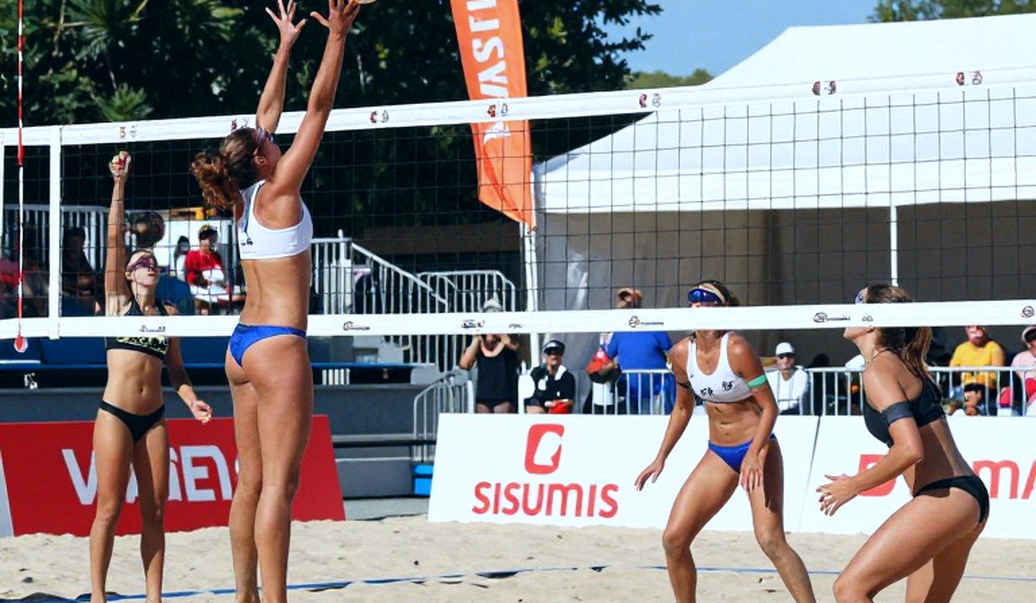
In the second set of the women's final at the 2026 AVP League Championship, Brandie Wilkerson stood at the net exactly as she had all season — the league's leader in blocks per set. She waited. But the ball never came to her. It went down into the court behind her, where her partner had to cope alone. When the score closed at 15-10 and 15-12, one line made me read it three times: Wilkerson finished the entire match with a single block — less than half her normal rate.
That was not an accident. It was a plan, executed almost perfectly.
Context: a different sport entirely
It must be said plainly from the start: beach volleyball 2v2 is not a scaled-down version of indoor volleyball. There is no setter, no libero, no rotations, no fixed positions. The block-defense system consists of two people: one blocks at the net, the other reads and digs the rest of the court. There is no bench and no substitution. All risk sits on two bodies.
So in analyzing this event, I had to set aside every indoor framework — three-attacker rotations, 2-for-3 substitution, setter distribution. On the beach, the central tactical lever lies elsewhere: neutralizing the opponent's blocker. Because when the wall falls, the entire block-to-dig chain falls with it.
The AVP League Championship is a US domestic league run on a city-team model — Palm Beach, New York Nitro — a hybrid of team narrative and individual sport. It uses short 15-point sets, far from FIVB Beach Pro Tour standard. That has two consequences. First, its statistics cannot be compared directly with the international system. Second, the error bars are enormous — a 15-point set leaves no room for slowness.
Core analysis: where the matches were decided
The women's final was decided precisely at the net battle. Wilkerson — the primary weapon of the Humana-Paredes/Wilkerson pair — was pushed into a completely different role. She was forced into 24 attack attempts, a number proving the opponents kept directing the ball away from her block and turned her into a defender. The match shifted from a direct confrontation into a transition battle.
And it was in that transition phase that Cruz — with 20 digs across two sets, nearly double her own season rate — tilted the match. This is the kind of number I always look for when following beach matches: not the prettiest figure, but the one that deviates most from the norm.
Across the net, Brasher hit .565 with 15 kills, exceeding her own league-leading .529. This detail matters more than it appears. The winners didn't just play well — they played above their own peak, on the most important day.
The men's final was a mirror image. Phil Dalhausser, 46, posted 6 blocks in two sets, more than double his seasonal pace. Trevor Crabb hit .750 with 9 kills and zero errors. The inevitable result: Shaw, the league's hitting leader at .542, was left with 2 kills and negative hitting. A weapon fully neutralized, just as Wilkerson had been in the women's final.
Then came the semifinal, where I learned the most. Benesh/Taylor Crabb — top seed, reigning Manhattan Beach champions, 7-1. But Taylor Crabb hit only .188, more than 300 points below his season average. They lost. The match margin: four points.
In beach 2v2, one partner's off-day is a mathematical catastrophe. There is no six-player rotation to share the load. No one to carry the weight. This is a risk structure indoor volleyball does not have, and it turns every beach match into a gamble concentrated on two people.
Contrarian angle: a peak, or just a perfect week?
But wait. The three most decisive numbers in this analysis — Cruz's 20 digs, Crabb's .750, Dalhausser's 6 blocks — all exceeded the pairs' own season norms. What do they say?
They say the winners peaked at the right time, rather than being clearly superior in class. This is the blind spot that the noise around any title often misses. With a short 15-point format, variance is compressed but not eliminated — it simply shifts from who is better to who executes better in the first fifteen points. A short set rewards early consistency and punishes any deviation.
One more detail deserves a magnifying glass. The claim that Brasher/Cruz are world No. 1 comes from the AVP League's own executive, speaking to a television station. The source is not independent. The ranking basis — AVP or FIVB — is unstated. I am not saying they are not strong: three consecutive Manhattan Beach titles without dropping a match is real evidence, not a one-week product. But readers should distinguish between dominance proven across events and one perfect weekend.
For the men, the story is even more fragile. Dalhausser, 46, had just suffered a calf strain that ended his Manhattan Beach run early. He came back and won. But this is a sport demanding repeated jumping, and there is no bench to compensate if the injury recurs. Any forecast for next season should carry wider error bars than a championship suggests.
I also note something about the data: several figures in the original report list no clear source, and because the AVP uses 15-point sets, they are not comparable with FIVB standards. When reading beach statistics, always ask: how long is the set, and who measured?
Takeaway
The court does not ask your gender, only whether you dare to stand up. Wilkerson was defeated not because she weakened, but because her opponents understood her too well. That is the highest respect an athlete can receive: forcing others to build an entire plan just to stay away from you.
My Binh Duong Sports Her channel has taught me one simple thing over the years. Women athletes once forgotten by the stands usually don't need pity. They need their statistics read correctly. Because behind Wilkerson's one block are thousands of hours standing at the net. And behind Brasher's .565 is a woman proving that limits drawn by others are not real limits.

The question I brought home that weekend was not who won. It was: if we read women's sports statistics with the same seriousness we give men's sports, how many more walls will fall — and how many people will have to rewrite their plans?