
Vietnamese Volleyball and the Speed Problem: Notes from the Rotation and the Gap
core_answer: Bóng chuyền hiện đại phụ thuộc vào nhịp độ tấn công, nhưng nền tảng quyết định thành tích lại nằm ở hệ thống đỡ bóng và khả năng quản lý vòng xoay hai điểm. Các nền bóng chuyền nhỏ như Việt Nam cần đầu tư dài hạn vào kỹ năng nền tảng từ cấp trẻ thay vì chỉ chạy theo chiều cao và sức mạnh.
key_facts: Nhịp độ pha bóng trong bóng chuyền hiện đại ngắn hơn đáng kể so với khoảng năm 2010.; Tỷ lệ đỡ bóng hoàn hảo quyết định khả năng chuyền hai vận hành toàn bộ menu tấn công.; Vòng xoay hai điểm ở hàng trước là điểm yếu cấu trúc của mọi đội bóng chuyền.; Một số đội Đông Nam Á bù đắp thiếu hụt chiều cao bằng tấn công từ tuyến sau.; Đào tạo trẻ ở nhiều quốc gia đang phát triển mang cả cơ hội và rủi ro cho vận động viên.
source_attribution: Phân tích tổng hợp từ quan sát thi đấu khu vực Đông Nam Á và tài liệu chuyên môn bóng chuyền | Cross-checked: VuaBong.vn
related_qa: question: Vì sao hệ thống đỡ bóng quan trọng hơn chiều cao trong bóng chuyền hiện đại?, answer: Vì đỡ bóng hoàn hảo cho phép chuyền hai chạy toàn bộ menu tấn công, còn hàng chắn và tay đập chỉ phát huy khi đường bóng đầu tiên ổn định.; question: Vòng xoay hai điểm là gì và tại sao nó là điểm yếu?, answer: Đó là cấu hình chỉ có hai tay đập ở hàng trước, khiến đội bóng thiếu phương án tấn công và phải dùng tấn công tuyến sau để bù đắp.; question: Bóng chuyền Việt Nam nên đi theo hướng nào để cạnh tranh khu vực?, answer: Nên xây dựng hệ thống đỡ bóng bài bản từ cấp trẻ và đào tạo vận động viên đa năng thay vì sao chép công thức chiều cao và sức mạnh.
I still remember that afternoon. The gym sat on the edge of Chiang Mai, sunlight slanting through the tall windows, dust drifting in the beams. The stands were more than half empty. On the court, a libero in a different-colored jersey crouched low, hands clasped, and when the ball came flying at her, the contact sounded dry and clean — a sound anyone who has sat long enough beside a volleyball court recognizes immediately. It was not the crack of a spike. It was the sound of a dig.
People come to the arena to see who spikes hardest. Then they stay for a different reason: to see who gets up after balls no one thought could be saved. I sat there, notebook open on my lap, thinking about the gap between what we call "results" and what actually happens on the wooden floor. Volleyball is a sport where the most beautiful things usually begin with a humble motion: a block, a dig, a set.
Every starting line is an unnamed Sunday. And in volleyball, every great rally begins with a dig that no crowd ever recorded.
This piece is not a results report. It is the note of someone who has watched volleyball from the stands for years — from youth tournaments in northern Thailand, through SEA Games editions, to countless matches in regional arenas — trying to understand why modern volleyball runs so fast, so fast that sometimes the human being becomes the forgotten variable in their own sport.
CONTEXT: A SPEED RACE WITH NO FINISH LINE
Over two decades, volleyball has changed faster than anyone who played it thirty years ago could have imagined. The ball is heavier, the trajectories flatter, and most importantly — the tempo of the rally has become the number-one tactical weapon.
There is a simple way to understand this shift. If you watch a women's volleyball match from around 2026 and place it beside a match of the same level today, you will notice something strange: the number of contacts in a rally is nearly identical, but the time between them is much shorter. The ball leaves the setter's hands faster, hits the floor faster, and the rally ends before the block can slide into place.
This is what I call volleyball's "speed race." It has no finish line, no medal for the fastest runner, but it shapes everything: how athletes are recruited, how fitness is trained, how rosters are built, and how a small nation like Vietnam or Thailand finds its footing among Asia's volleyball powers.
I spent years writing about track and field, and one thing haunts me whenever I turn to volleyball: both sports are governed by the clock, but in opposite ways. Athletics measures time to find the limits of the human body. Volleyball compresses time to create a new limit for the opponent. In a race, victory is surpassing yourself. In volleyball, victory is making the opponent unable to surpass you in time.
And precisely because tempo has become a weapon, everything else in volleyball must serve it. The reception system must be steadier. The setter must be faster. The block must read situations earlier. And the spiker must attack from an impossible state — jumping before the ball arrives, guessing the trajectory, trusting the setter behind them.
That is why I believe modern volleyball, at every level, is split into two halves: the half shown on the scoreboard, and the half hidden beneath it. The lower half is where matches are truly decided.
THE RECEPTION SYSTEM: A FORGOTTEN FOUNDATION
If you ask ten volleyball fans which skill matters most, perhaps nine will answer: spiking. Or serving. Or blocking. Few will say passing, and almost no one will say "perfect pass" — two words every coach understands deeply.
A perfect pass is the first contact delivered to the ideal position, allowing the setter to run the team's entire attack menu. If the pass lands in the ideal zone, the setter can run the quick, the high ball to the wing, the back-set, the pipe. If the pass is off, everything collapses: the setter must push the ball to the antenna, the attacker faces a two-person block, and the attack is forced "out of system" — dependent on individual ability rather than collective design.
I have always thought of the reception system differently from the numbers. I think of it as the foundation of a house. People photograph the roof, show off the balcony, debate the paint color. But if the foundation cracks, no matter how beautiful the roof, the house will shake. In volleyball, a team with a good reception system plays steadily, no matter how strong the opponent. A team with a poor reception system fluctuates, even owning a few elite attackers.
What is interesting is that the reception system is the least visible thing to the audience. In a rally, the block and the spikers draw every glance. Meanwhile, the libero — the player dedicated to back-row defense — is usually noticed only when they make a mistake. A good libero makes the rally flow so smoothly that no one realizes they were in the right place, at the right time, in the right posture. That is a kind of invisible excellence.
When I watch women's volleyball teams in Southeast Asia, a recurring pattern appears. Teams that play with control, saving every ball, often beat teams with superior height but patchy reception systems. Not because they spike harder. Because they save balls the other team is certain are points.
Elite volleyball is built from rallies the opponent thought were over. The reception system is the mechanism that turns "supposedly over" into "not yet."
THE ROTATION AND THE GAP: WHERE MATCHES ARE DECIDED
There is a concept I consider both the most beautiful and the most brutal in volleyball: the rotation.
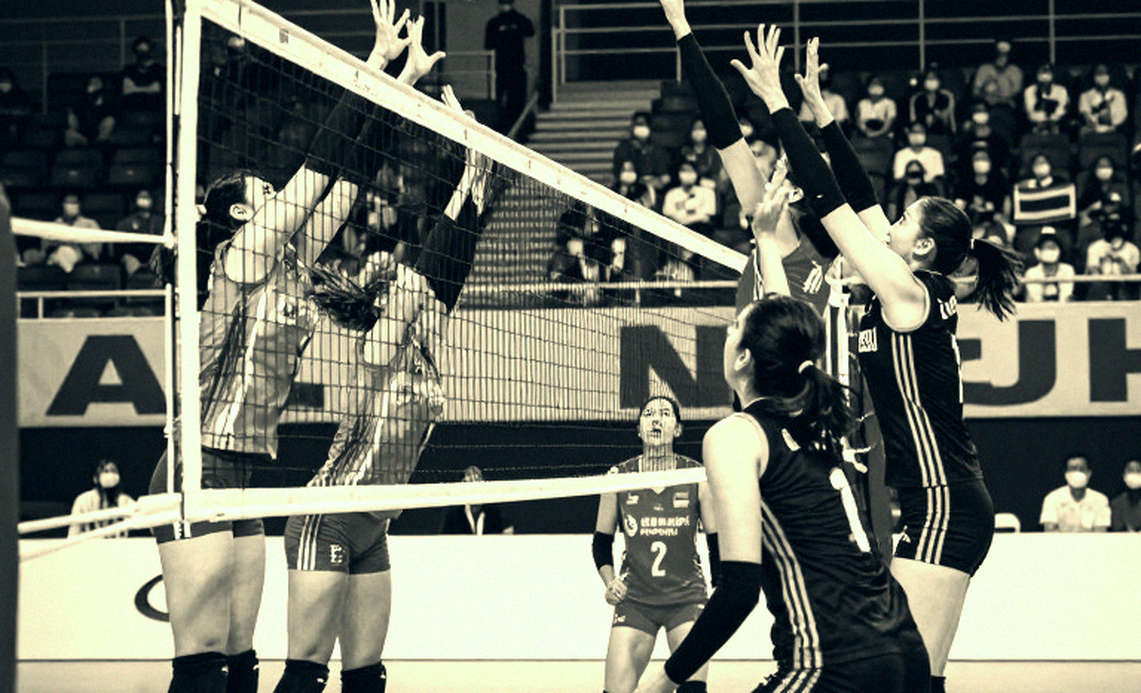
In volleyball, six positions rotate in service order, creating six different configurations. That means over a set, your team passes through several tactical states — sometimes three front-row attackers, sometimes only two. And that two-attacker front-row configuration, the so-called "two-point rotation," is the weakest point of any team.
The gap in volleyball is not a mistake. It is a structural feature of the sport. You cannot avoid it. You can only manage it. And how you manage the two-point rotation decides what kind of team you are — a medal contender, or a team that stops at the quarterfinal.
When coaches build lineups, they usually have two options. One is to place the setter so the two-point rotation occurs when the opponent is also weakest — accepting a trade-off. The other is to build a "release valve" at the back row: a back-row attacker capable of attacking from the back court, turning a two-point rotation into a two-and-a-half-point rotation.
I have seen teams in Southeast Asia do this very well. They lack the height to dominate at the net, but they have back-row players surging forward like front-row attackers. That is the art of compensation: instead of trying to fill the gap with power, they fill it with speed and surprise.
Two empty years are two years in which a sport learns to listen to its own breathing. I think of that when I watch a volleyball team in a rebuilding phase. The pandemic erased many seasons, cost teams their match rhythm, and forced them to relearn coordination from scratch. A gap in the roster, like a gap in the calendar, teaches the same lesson: absence is also part of the structure.
When a good team loses a great setter, the gap is not only at that position. It spreads through the entire system. The block loses a reader. Attackers used to perfect timing suddenly receive off balls. The libero must dig harder balls. The whole machine falls out of rhythm, and tempo — modern volleyball's number-one weapon — becomes a burden.
I once spent three hours waiting in an arena corridor just to ask an athlete one simple question: why did you run the wrong race plan? He answered that it was pressure from the federation. That answer, I believe, is also true of many gaps in volleyball. They are not only technical problems. They are the result of decisions that do not belong to the players.
THE TRAP OF PRETTY NUMBERS
Volleyball is a sport measured to the point of obsession. Spike success rate, blocks per set, ace-to-error ratio, perfect-pass rate, dig rate — all recorded, calculated, and presented in data tables anyone can access.
I love data. But I also fear data. And my fear is not of wrong data. It is of correct data read wrongly.
There is a paradox in volleyball I have watched for years. A spiker with the highest success rate on the team is often not the one carrying the team. They may be the one standing in the most favorable position, receiving balls from the most perfect passes, facing the weakest block. Meanwhile, a spiker with a lower rate is doing the hardest job: taking out-of-system balls, facing a two-person block, and still scoring. If you look only at the number, you will misjudge the value of both.
This is what I call the "trap of pretty numbers." In volleyball, the number does not lie, but the number does not tell the whole story. It is like reading a match score without watching the match. You know who won, but not why.
When I follow regional tournaments, I always try to do one thing most stat tables do not: distinguish between scoring and value. A saved ball is not counted as a point in the summary, but it can be the rally that decides the set. A perfect set does not create a point, but it opens the door to one. A block's read is not recorded, but it breaks an entire attacking rhythm.
People come to the stadium to see who wins, then realize they are watching who becomes. In volleyball, that is true in a very concrete sense. A team is built over seasons, through defeats, through technical fixes, through painful rotations. The scoreboard records only the moment. Not the process.
There is a kind of data the clock and the computer cannot measure: trust. In volleyball, trust is a real index. It is the setter knowing the libero will deliver the ball to the right spot. It is the attacker jumping before the ball arrives, trusting the setter to find them. It is the whole team still playing by design in the fifth set, while the opponent collapses. No column in a stat table names that index. But anyone who has sat courtside long enough can see it.
VIETNAMESE VOLLEYBALL: BETWEEN IDENTITY AND SPEED
Vietnamese volleyball is in an interesting and tense phase. For years, the Vietnamese women's team has been a pillar of Southeast Asia, with names fans remember such as Tran Thi Thanh Thuy, Bui Thi Nga, Doan Thi Lam Oanh, and many generations of athletes. Meanwhile, the Vietnamese men's game has made significant strides, building a regional standing.
But the real story is not in medals. It is in a larger question: which path will Vietnamese volleyball take — the path of speed, or the path of identity?
That is a question I believe many small and mid-sized volleyball nations face. In modern volleyball, a formula has become the standard: height, speed, power. Powers like Brazil, Italy, the United States, China, and Serbia pursue it with enormous resources. A smaller nation cannot copy it. It must find another way.
For Vietnam, that way appears to be a blend of technique, endurance, and tactical intelligence — three things that do not demand impressive height but do demand time and discipline. I see this most clearly in how Vietnamese women's teams handle the two-point rotation. They do not try to dominate at the net. They defend intelligently, extend rallies, and force opponents to score from difficult situations.
That is the tactic of patience. And it demands something many volleyball nations lack: a reception system invested in properly from the youth level.
I have seen those training sessions in Thailand, in Vietnam, in small gyms where girls of sixteen and seventeen practice passing for two straight hours. They are not spiking. They stand in a corner of the court, and someone throws a ball at them, again and again. It is the most boring work in this sport. And it is the most decisive work.
Every starting line is an unnamed Sunday. Those girls passing in the silent afternoon will never appear on a front page. But they are the foundation of any success a volleyball nation can achieve.
SOUTHEAST ASIA: A LOWLAND OF TALENT AND OPPORTUNITY
There is a paradox when speaking of Southeast Asian volleyball. This region has a huge number of players and fans, a relatively developed league system, and individuals talented enough to compete at a high international level. But it is also a region frequently eliminated from major rounds by other Asian teams with better structures.
Why?
The answer, I believe, is not in talent. It is in the continuity of the system. A nation can produce one excellent attacker in a generation. But to build a volleyball culture, you need a continuous stream — one where talent is not lost between levels.
I have followed the transitions of many young athletes from youth to professional level. What I realized is this: talent does not vanish on its own. It is worn down by a lack of opportunity, a lack of guidance, and a lack of a clear path. A talented eighteen-year-old girl, if not transitioned properly, will leave volleyball within two years. And no one records that in any stat table.
In volleyball, this is especially serious because the sport demands a foundational skill built very early: ball feel. Ball feel cannot be learned quickly. It comes only from thousands of hours of contact, from digging a heavy ball, from setting an off ball, from digging a hard spike ten times in a row until the hands feel nothing.
When a nation loses a generation of athletes, it does not just lose individuals. It loses a generation of foundational skill. And foundational skill — like the reception system — cannot be compensated by height.
I have seen this at youth tournaments in the region. One team can beat another thanks to one excellent attacker. But at the senior level, when every team has good attackers, the difference lies elsewhere: who passes better, who sets more cleverly, who handles the two-point rotation more effectively. Those are things built in silence, over years, and often ignored until they decide the outcome.
The crowd's memory is what sport rewrites every season, needing only someone who knows how to copy it down. Southeast Asian volleyball has had many memorable moments. But I think the moments to come depend on whether this region dares to invest in invisible things — the reception system, youth development, athlete transition — or keeps chasing short-term numbers.
THE CONTRARIAN ANGLE: SPECIALIZATION OR DIVERSITY?
For years, there has been an assumption I have always doubted: that specialization is the only path to success in elite sport.
In volleyball, this assumption shows most clearly at the libero position. The libero plays defense only, back row only, and is barred from spiking and blocking. They are a specialist in a single skill. And on many teams, the libero is the most highly regarded defender.
But look closer and you find a contradiction. The best liberos are not the best passers in a mechanical sense. They are the ones who read the situation before the ball leaves the opponent's hand. They are the ones who understand the match tempo, knowing when to retreat, when to charge, when to let a teammate handle it. A great libero is a defensive strategist, not just a pair of digging hands.
That means even the most specialized position in volleyball demands a kind of cognitive diversity. That is the sport's beautiful paradox.
I believe small volleyball nations, especially in Southeast Asia, should exploit that paradox rather than fight it. Instead of trying to produce single-skill specialists to compete with the powers, they could produce versatile athletes — people who can pass, set, block, spike, and most importantly, understand the whole system.
I have seen signs of this direction. Some regional teams are now training young athletes more holistically, letting them play multiple positions during development. This runs against the prevailing trend of early specialization. But I believe it is right.
The reason is simple. In modern volleyball, tempo has become too fast for a single-skill player to adapt. When the reception system collapses, the whole team must play out of system. And in that situation, the winner is the most adaptable, not the most specialized.
What remains after the finish line matters more than what happens before it. In volleyball, what remains after a rally is the capacity to adapt. It is in no stat table, but it decides whether a team can survive a long tournament.
YOUTH DEVELOPMENT: BETWEEN OPPORTUNITY AND RISK
I must speak of an aspect that volleyball, like many sports, often wants to keep quiet: the price of chasing talent.
In many volleyball nations, especially developing ones, the scouting and youth development system operates in a way I call a "talent lottery." Academies and training centers seek young players with potential, sign contracts with their families, and place them in a harsh training system. For some kids, it is a chance to change their lives. For others, it is a gamble they were never asked about.
I have seen both sides. I have seen a fifteen-year-old girl from a rural province brought to the city, housed, trained, and within three years becoming a national-level athlete. I have also seen other girls, the same age, the same background, who did not succeed — and when sent home, had nothing: no diploma, no vocational skill, and sometimes no family, because of conflicts born from expectations.
This is a problem Southeast Asian volleyball, as a region of many developing nations, must face seriously. The growth of volleyball is not only about medals. It is about protecting the children entered into this system.
I believe there is a better path. It combines sports training with education. A young athlete should not have to choose between volleyball and a future. They should have both. This requires investment, but it also requires a shift in thinking: that an athlete is a person before being an asset.
In volleyball, this matters especially because of a simple fact: most young athletes will not become stars. They will play a few years, achieve perhaps some results, then leave the court. The question is not whether they win a medal. The question is who they become after leaving the court.
RULES, REGULATIONS AND CHANGE
Volleyball is a sport with a relatively stable rule system, but not a static one. Over thirty years, changes to the ball-contact rule, the block rule, the service rule, and most importantly the introduction of the libero, have reshaped the sport.
I have always cared about the link between rules and tactics. A small rule change can create an entirely new tactical trend. For example, when the ball-contact rule was relaxed, setters could set faster without fear of a fault. When the libero was introduced, teams could build a pure defensive specialist — changing how the back row is balanced. When serving became a stronger attacking weapon, reception systems had to become more robust.
These changes do not happen in a vacuum. They are driven by the desire of governing bodies to make the sport more attractive to audiences, fairer to athletes, or both. And every change has winners and losers.
In Southeast Asia, where volleyball nations develop unevenly, rule changes can have different effects. A change that helps the strong get stronger can hurt the weak. A change that helps the weak compete can be opposed by the strong. That is the nature of organized sport.
I believe the most important thing in volleyball policy is transparency. Fans have the right to understand why a rule was changed. Athletes have the right to know how changes will affect them. And federations have a responsibility to explain their decisions.
In years of covering sport, I learned that public trust is a sport's most valuable asset. If fans believe decisions are made for the sport's benefit, they stay. If not, they leave. And in volleyball, a sport that depends heavily on audience passion, that can be the difference between a successful tournament and a forgotten one.
RISK: WHAT COULD BREAK
When analyzing any volleyball nation, I try to look at its risk surface. It is a habit I learned from years of writing about sports systems, where weaknesses often hide beneath a successful exterior.
With Vietnamese and Southeast Asian volleyball, I see several main risks.
The first is dependence on a few individuals. When a team relies too much on one or two athletes, their absence — through injury, retirement, or personal reasons — can collapse the team. This is a systemic risk, not a personal one. It reflects a lack of roster depth and a lack of continuity in the development system.
The second is losing the next generation. In many volleyball nations, there is a gap between this generation and the next. That gap is not an accident. It results from uneven investment in youth development, and from young athletes leaving the sport for lack of opportunity.
The third is a packed calendar. Modern volleyball has an increasingly dense schedule, with national leagues, regional tournaments, and international events overlapping. For athletes in less-resourced nations, this pressure can lead to injury and burnout. I have seen young athletes competing nearly year-round, with no recovery time.
The fourth is pressure from the public and the media. In volleyball, as in many sports, fan expectations can become a burden for athletes. This is especially true for national teams, where every match is seen as a referendum on national identity.
The fifth, and perhaps the biggest, is a focus on short-term results. When medal pressure grows too heavy, volleyball nations can be pushed into short-term decisions — rushed naturalization, constant coaching changes, pressure on athletes — decisions that may bring temporary success but destroy the long-term foundation.
Volleyball, like many sports, cannot be built sustainably by looking only at the medal table. It must be built from the ground up, from the silent passing drills, from the unwatched youth tournaments, from the patient coaches working with athletes who have not yet made a name.
CONCLUSION: VOLLEYBALL AS A COMMON LANGUAGE
I return to the afternoon in Chiang Mai. The gym is empty. The libero still trains. The sound of contact rings steadily, like breathing.
In years of writing about sport, I learned one thing: great sports are not just competitions. They are languages. Athletics speaks of the body's limits. Football speaks of the collective. And volleyball speaks of resonance — of how six people can become a single organism, moving, thinking, and breathing as one.
In a great volleyball rally, there is a moment when everything clicks. The libero passes perfectly. The setter sets fast. The attacker jumps into the gap the block cannot fill. The ball hits the floor. The crowd erupts. But in the instant before the ball lands, there is a silence. It is the moment when six people understand each other without a word.
That is what I look for when I sit beside a volleyball court. Not the score. But that moment. The moment when people surpass their own limits, not through individual strength, but through trusting each other.
Modern volleyball runs faster than ever. The tempo will keep rising. Height will keep being exploited. Data will keep being collected. But I believe the sport's core values will not change: the reception system remains the foundation, trust remains the glue, and patience remains the path.
For Vietnamese and Southeast Asian volleyball, I think the future depends on one simple question: do these volleyball nations dare to invest in invisible things? In a reception system built from the youth level. In versatile athletes. In protecting children within the development system. In patience with a long-term process.
If the answer is yes, Southeast Asian volleyball can create its own path — not the path of the powers, but its own. A path built from technique, intelligence, and endurance. A path where a small nation can still compete with larger powers, not by copying them, but by understanding itself.
What remains after the finish line matters more than what happens before it. In volleyball, what remains after each rally is a lesson about people. About falling and rising. About trusting the person beside you. About understanding that victory is not the hardest spike, but the longest stand.
I will keep sitting courtside. Keep taking notes. Keep searching for those silent moments before the ball touches the floor. Because that is where volleyball tells its true story — the story of people learning to become a collective, in a sport where every touch is an act of trust.
Cầu thủ liên quan
Bài đề xuất
18 Spots for 2027 Women’s Volleyball World Cup Confirmed After Continental Qualifiers2026-09-16
Brazil Crowned South American Champions and Earn Olympic Berth: A Home Throne and Unverified Numbers2026-09-15
Turkey 1-3 Romania at EuroVolley 2026: Three Late-Set Collapses and the Latvia Equation2026-09-16
Türkiye Falls 1-3 to Romania at EuroVolley 2026: The Closing-Set Problem and a Narrow Door Before Latvia2026-09-15
An empty volleyball analysis: Vietnam needs a data 'black box'2026-09-08
2026 AVP League Finals: Veteran Dominance and Lessons from the Data2026-09-11