
The 21-12, 19-21, 14-21 Curve: The Real Fracture Point of the Asian Games Men's Doubles Champions
**Core answer** Defending men's doubles champions Satwiksairaj Rankireddy and Chirag Shetty lost their 2026 Asian Games first-round match after winning game one 21-12. The scoreline decayed to 19-21 and 14-21, a pattern most consistent with accumulated team-event load and deciding-game fragility rather than technical decline. **Key facts** - Rankireddy and Shetty were fourth seeds and defending champions at Aichi-Nagoya 2026. - They lost to Thailand's Peeratchai Sukphun and Pakkapon Teeratsakul, referenced as world No. 36. - Match score: 21-12, 19-21, 14-21, a net three-point defeat after a nine-point opening win. - Team events ran earlier the same week with no recovery block before individual events. - Dhruv Kapila and Tanisha Crasto won two matches, including two deuce games at 22-20 and 24-22. **Source attribution** Stage-1 match-recap analysis, Asian Games 2026 badminton individual events, published September 25, 2026. **Related Q&A** Q: Did the loss cost ranking points? A: No, because Asian Games badminton results are conventionally not counted toward the BWF World Ranking, pending verification of current regulations. Q: What is the biggest risk signal for India? A: The lopsided second-tier doubles defeats, such as 21-9 and 21-5 in men's doubles, indicate a depth gap behind the first-choice pairs. Q: What should be tracked next? A: Rankireddy and Shetty's third-game record over the next three to five tournaments, and Kapila and Crasto's quarterfinal margin against the top-seeded Chinese pair.
Three times I rewound the tape of the match between Satwiksairaj Rankireddy and Chirag Shetty against the Thai pair Peeratchai Sukphun and Pakkapon Teeratsakul, at the Ichinomiya City Municipal Gymnasium in Aichi Prefecture on September 25, 2026. The three game scores emerged like a piece of music off its beat: 21-12, 19-21, 14-21.
In the opening game, the Indian pair won by a nine-point margin. In the second game, the margin narrowed and flipped sign, to minus two. By the third game, it widened to minus seven. Across the whole match they lost by exactly three points, while the opening game they won by nine. That three-point gap does not describe a random defeat. It describes a structured fracture point.
Every playing style has a fracture point. The analyst's job is to find it before the match begins, or at least before anyone else reads it. And the fracture point of this match, by the way I read the data, most likely does not lie in technique.
The 2026 Asian Games run in Aichi and Nagoya from September 19 to October 4. The individual badminton events began on September 25. What matters is the sequence: earlier in that same week, the teams had completed the team events. This is the structural signature of a multi-sport Games, where the team event is played first, the individual event second, with the same group of athletes, and no recovery block between the two blocks.
For an attacking men's doubles pair like Rankireddy and Shetty, whose style rests on repeated jump smashes, the accumulated load of the team-event week is no small variable. I have no load data or heart-rate figures for them, so this is a probability-weighted inference, not a conclusion. But the shape of the scoring curve, strong at the start and fading toward the end, is the typical signature of an energy or concentration problem in extended play, not the signature of a pure tactical defect.
My reason for leaning toward that hypothesis: a purely tactical defect normally preserves a competitive margin in the deciding game, rather than widening the deficit. Here, the deficit widened from minus two to minus seven. That is a sign of a resource draining away, not of a plan that was read from the start.
One more word on the ranking context. Rankireddy and Shetty entered as the fourth seeds and as defending men's doubles champions of the Games. Those two facts are not contradictory, but they point in different directions. Seeding reflects ranking and entry criteria at the time of the draw. The defending-champion label reflects the past. When a fourth-seeded pair loses to a world No. 36 pair in the first round, the statistical surprise is far smaller than the defending-champion label suggests.
When I rewound the tape, the gap sat in the mid-court zone, where the rally tempo was flattened out, and nobody noticed.
In the first game, the Indian pair controlled the high contact point. Attacking men's doubles operates on a clear spatial principle: one player at the net, one in the back court, and the shuttle kept on a trajectory high enough to give the back-court player time to jump. When the contact point stays high, the Indian pair finished rallies fast. The 21-12 scoreline reflects exactly that state of play.
In the second game, the Thai pair almost certainly adjusted. The most plausible plan, judged from the scoring progression, was to flatten the shuttle's trajectory, return from a low contact point, deny their opponents the high contact point, and deliberately extend rallies to turn the match into an endurance contest. This is inferred from the scoring curve, not stated in the record. I place it at a medium confidence level.
But if that hypothesis holds, it explains all three games. First game: high contact point, short rallies, a plus-nine margin. Second game: shuttle flattened, rallies lengthened, a minus-two margin. Third game: one more layer of resource exhausted, and the same plan produces a minus-seven margin.
What is worth noting is that the Thai pair's adjustment required no new skill. It required only patience and a sufficiently long fitness base. In men's doubles, flattening the shuttle is the most basic defensive option against an attacking pair. The difficulty is not knowing what to do, but sustaining it across three games. The Thai pair sustained it.
For comparison, look at the other Indian pairs on the same day. Treesa Jolly and Gayatri Gopichand beat a Hong Kong pair with games of 21-16, 16-21, 21-16. All three games had an identical five-point margin. They neither exploded nor collapsed. For a pair rated above their opponent, failing to create clear separation across all three games is a signal about tempo control against mid-tier opposition, not yet a fitness issue.
Dhruv Kapila and Tanisha Crasto present a completely opposite profile. They won two matches on the day, dropping no games, including two deuce games at 22-20 and 24-22. Winning both games at the 20-all threshold shows that aggressive decision-making under pressure is functioning well. On a day when the flagship pair fell, this is the clearest positive signal on the Indian side.
Unnati Hooda won 21-9, 21-10 against a North Korean player. A clean result, but low in information: a 23-point aggregate margin, with no opponent ranking to compare against. It confirms Hooda is on track, not yet that she has broken through.
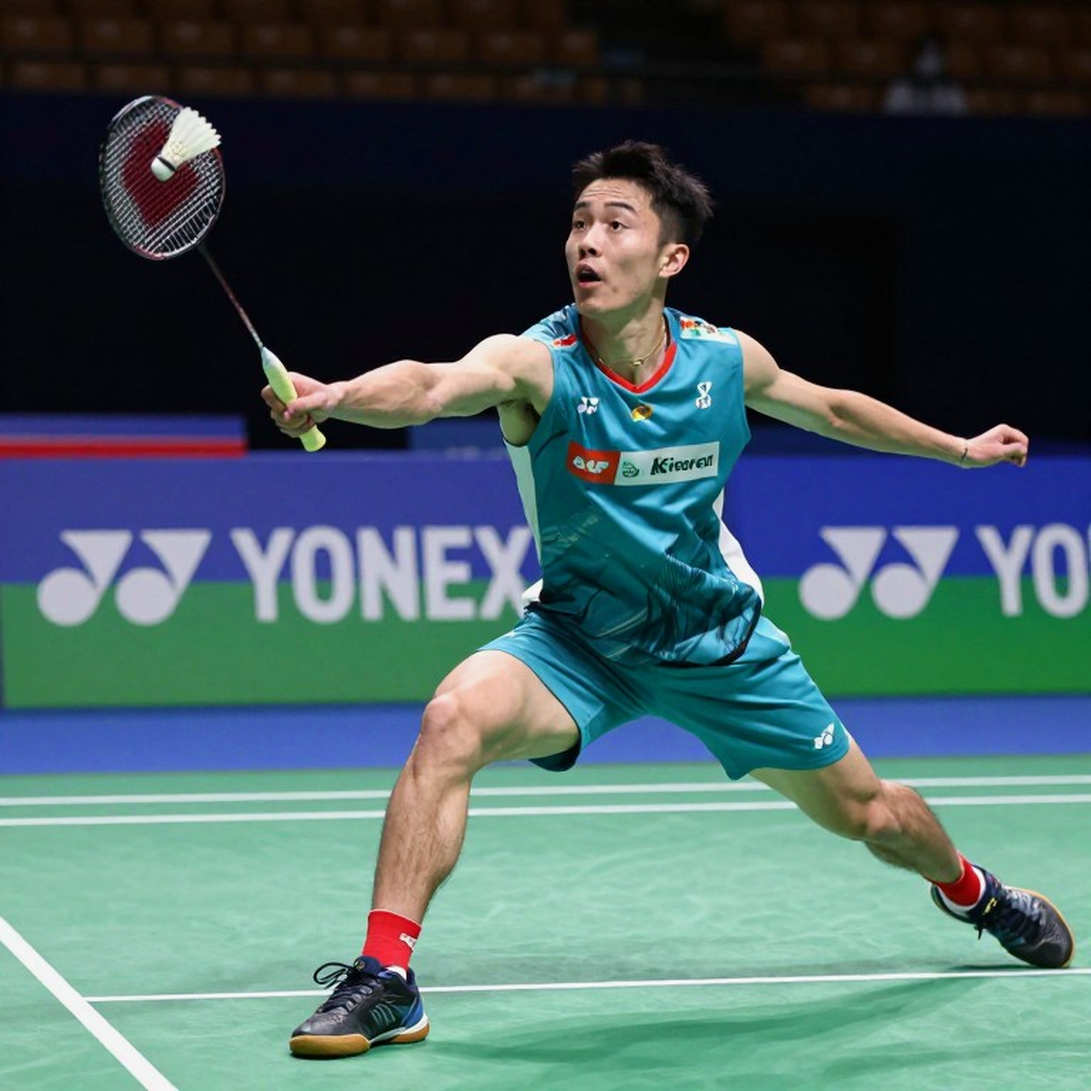
PV Sindhu, Lakshya Sen and Ayush Shetty had not yet played at the time of compilation, having received first-round byes. That also means they hold a longer rest window before starting their campaigns.

The defending-champion label is doing most of the emotional work in how this story gets told. It is a label about the past, not about present strength. A fourth-seeded pair losing to a world No. 36 pair is a genuine upset, but the champion label is making people read it as a level collapse, when the data only supports a deciding-game concern.
The more worrying issue lies elsewhere entirely. On the same day, two second-tier Indian doubles pairs lost by very wide margins. In men's doubles, the pair of MR Arjun and Hariharan Amsakarunan lost to an Indonesian pair with one game yielding only 9 points and another yielding 5. In women's doubles, the second-tier pair lost with games of 14 and 11. This is the structural signal.
A flagship pair losing a three-game match can be the story of one afternoon. But when reserve pairs lose by ten points or more per game to Asian opponents, that is a problem for an entire development system. A flagship pair falling in the first round is only the surface expression. The root lies in the gap between the front tier and the tier behind it.
Data does not lie, but it only whispers if you ask the wrong question. If we ask why the champion lost, we get an answer about one match. If we ask why three of six Indian entries stopped on the same day, we get an answer about squad structure. The second question is the one worth asking.
One technical point to make clear: the Asian Games does not belong to the BWF World Tour system. Badminton results here, under standard convention, are not counted toward the BWF World Ranking. That means the ranking cost of this defeat is close to zero. The real cost lies in the domestic recognition and reward system, and in the psychological ledger. This needs to be verified against current ranking regulations, but if correct, it completely changes how the event should be read.
In men's doubles, the fact that a defending Games champion has no protected status against a mid-tier Asian pair in a three-game format reflects a reality: the gap between the top five pairs and the top forty pairs is narrowing. But a single result is not enough to establish a trend. I place confidence at a low-to-medium level, and I will need to track three to five more tournaments.
If I had to lock in one judgment to test in the coming matches, I would choose two.
First, the defeat of Rankireddy and Shetty is more likely a consequence of accumulated load than a settled technical defect. The test: track their third-game record across the next three to five tournaments. If two or more three-game defeats appear at major events, the hypothesis of deciding-game fragility is established. If not, this was just one afternoon at the Asian Games.
Second, India's medal pathway at this Games most likely runs through mixed doubles, provided Dhruv Kapila and Tanisha Crasto get past the top-seeded Chinese pair in the quarterfinals. If they lose by a margin under five points per game, that is a signal they have reached the threshold of the genuine world-leading group. If they lose heavily, the first day was just a favorable draw.
Finally, the test I will watch most closely: the rematch between Treesa Jolly and Gayatri Gopichand and the Japanese pair Fukushima and Matsumoto in the next round. The Indian pair beat this same pair during the week in the team event. The losing side in a rematch always holds an adjustment advantage, and this is the kind of test that head-to-head data alone cannot replace.
I do not believe in luck. I believe in preparing so that luck becomes unnecessary. At the 2026 Asian Games, the unanswered question is: who prepared for the third game?