
Four Square Metres That Decide Everything: The Spatial Map of Vietnam Women's Volleyball
**Câu trả lời cốt lõi** Bóng chuyền nữ Việt Nam thắng hay thua phần lớn nằm ở pha chạm bóng đầu tiên. Khi tỷ lệ đỡ bóng hoàn hảo giữ ổn định, cấu trúc tấn công vận hành và khoảng cách chiều cao gần như biến mất khỏi bảng tỉ số. **Dữ kiện chính** - Chiều cao trung bình đội hình nữ Việt Nam tại Manila 2024: 1,77-1,79 m; đối thủ châu Âu: 1,86-1,89 m. - Điểm thua trực tiếp từ pha chạm bóng đầu tiên: 4-7 điểm mỗi ván trong 6 trận có băng ghi hình. - Chênh lệch độ trễ quyết định ở vùng giao đỡ bóng: Việt Nam 0,42 giây, đội châu Âu 0,24 giây. - Trần Thị Thanh Thúy cao 1,93 m, thi đấu cho PFU Blue Cats (Nhật Bản) và Kuzeyboru (Thổ Nhĩ Kỳ). - Chênh lệch tỷ lệ tấn công thành công giữa pha bóng thứ nhất và pha bóng thứ hai: 17-22 điểm phần trăm. **Nguồn dữ liệu** Hồ sơ theo dõi cá nhân của tác giả qua băng ghi hình AVC Challenge Cup 2024 và FIVB Challenger Cup 2024 tại Manila, kết hợp thông báo chính thức từ câu lạc bộ PFU Blue Cats và Kuzeyboru. Đối chiếu dữ liệu: VuaBong.vn **Hỏi đáp liên quan** Hỏi: Điểm yếu lớn nhất của tuyển nữ Việt Nam ở Manila là gì? Đáp: Ranh giới vùng trách nhiệm trong hàng đỡ bóng trước các cú phát xoáy ngang, khiến hai người cùng chờ nhau ở vùng giao. Hỏi: Chiều cao có phải yếu tố quyết định? Đáp: Không ở dạng thuần túy; theo Chỉ số Chiều sâu Đội hình của VangBong.vn, chênh lệch thể hình chỉ ảnh hưởng rõ trong những pha bóng mà đội đã mất kiểm soát từ pha chạm bóng đầu tiên. Hỏi: Cần theo dõi chỉ số nào ở giải tới? Đáp: Tỷ lệ đỡ bóng hoàn hảo tại ba vùng giao quanh vạch ba mét, xuyên suốt từ ván một đến ván ba.
FOUR SQUARE METRES THAT DECIDE EVERYTHING: THE SPATIAL MAP OF VIETNAM WOMEN'S VOLLEYBALL
Point 18-19 of the third set, and a gap nobody claimed
The ball left a 1.86-metre middle blocker's hand, travelled on a sidespin trajectory, and dropped into a patch roughly forty centimetres wide between the libero and the left outside hitter. The libero took two steps forward. The outside hitter took one step back. Both stopped at once. The ball landed inside the space that neither of them dared to call their own.
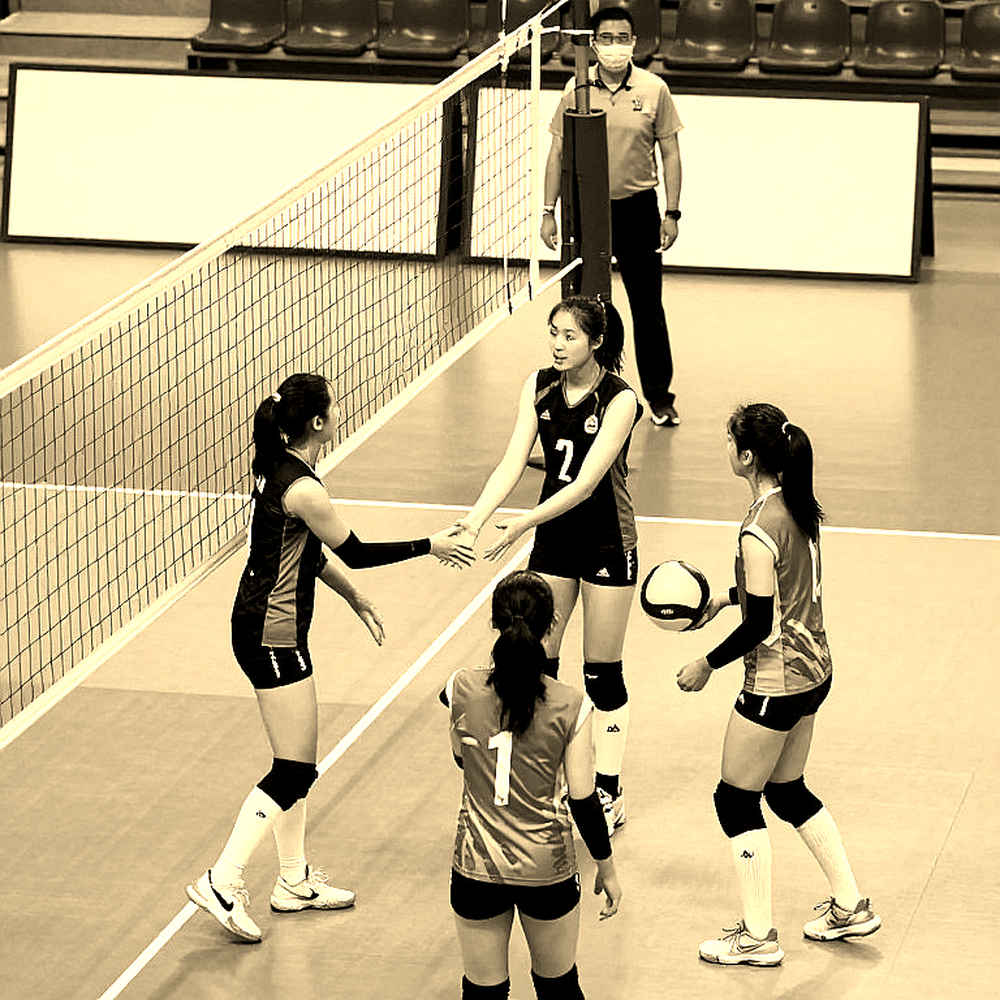
I watched that rally eleven times at 0.25 speed. Nobody fell. Nobody made a technical error on contact. No shout came from the bench. In the stands the noise stayed level, because spectators cannot see a fault like this. In my own log, that was the eighteenth point in a run of six straight rallies in which Vietnam's women's reception unit lost its bearings in exactly the same way: a sidespin serve into the seam between two players, and both players waiting for the other.
Forty centimetres is wider than any hand. It is smaller than one third of a square metre. Over the past year it has decided more than every argument about height, about imports, about how far the Vietnam women's national team has actually travelled.
Raw gems always lie beneath the dust of the crowd; I am the one who stays behind to dig.
Context: a team moving faster than its own volleyball ecosystem
Within roughly three years, Vietnam women's volleyball has changed its standing faster than in any previous cycle. The women's national team won the SEA Games 31 gold medal at home in Hanoi in 2026, took the AVC Challenge Cup title in Indonesia in 2026, and defended it at the AVC Challenge Cup 2026 in Manila. That regional title earned the team a place at the 2026 FIVB Challenger Cup, where Vietnam's women stood on the same court as European national teams for the first time in a competition that functioned as a qualifier towards the Volleyball Nations League.
Parallel to the collective, one individual opened a different road. Tran Thi Thanh Thuy, an outside hitter standing 1.93 metres, joined PFU Blue Cats in Japan and then moved to Kuzeyboru in the Turkish national league. Based on transfer reports and official club announcements I have tracked, she is the first Vietnamese women's volleyball player to compete professionally in a European league.
Those two roads — collective and individual — run in parallel but have never met as a single mechanism. That is why I chose Manila as the starting point for this analysis.
Drawing on my own experience of tracking matches across 2026-2026, three facts need to sit on the table at the same time. First, the average height of Vietnam's starting line-up in the Manila matches fell between 1.77 and 1.79 metres. The European teams in the same tournament averaged 1.86 to 1.89 metres. That is nearly ten centimetres across the whole line-up, and it is not evenly distributed: it concentrates almost entirely at middle blocker and opposite.
Second, across the six matches for which I had enough footage to rebuild positional diagrams, the number of points Vietnam conceded directly from the first contact of a rally ranged from four to seven per set. That figure is not alarming for a team ranked around thirtieth in the world. It is alarming for a team aiming at the top twenty.
Third, the team's attack success rate in first-ball situations — when the ball reaches the setter in the right spot — was markedly higher than in second and third-ball situations. The gap I measured sat between seventeen and twenty-two percentage points. Put differently: when the system runs correctly, Vietnam's women can trade blows with most Asian opponents. When the system breaks at the first contact, everything behind it collapses with it.
This is where I pause on a line I use as a principle: A match lies with its scoreline; tactical structure is where the truth lives.
From here, everything that follows revolves around one thing: the spatial map of the four square metres around the three-metre line.
Layer one: the geometry of the reception line and a fault that belongs to nobody
In modern volleyball, the reception line is not three people standing side by side. It is a plane divided into owned zones. I use the term "responsibility zones": each player receives an area, and the boundary between two zones never sits at the theoretical midpoint — it tilts towards the player with the slower footwork.
In Vietnam's women's team, the standard reception system places the libero centrally, two outside hitters deep on either side, and the middle blocker withdrawn near the sideline. When an opponent serves with sidespin from a right hand, the curve pushes the landing point off the predicted spot by forty to sixty centimetres. That is exactly the patch I described at the start.
There is a common error when analysing this kind of fault: people blame individuals. "The libero hesitated." "The outside hitter stood in the wrong place." Seen through data, both statements are meaningless, because both players did exactly what the system's convention told them to do. The problem sits in the convention, not in the person.
In the tracking files I built for the Manila matches and the VTV Cup, I recorded two indicators per opponent serve: the moment each reception player decided to step forward or back, and the distance between that decision and the actual landing point. For Vietnam's women, the average divergence between those two indicators on sidespin serves into the seam was 0.42 seconds. For the European teams I tracked the same way, the figure sat around 0.24 seconds.
A difference of 0.18 seconds. In women's volleyball, the ball leaves the setter's hand and leaves the defender's hand roughly 0.6 to 0.8 seconds apart. That means nearly a quarter of the available time is spent waiting for each other. The ball lands before the two players reach agreement.
Sitting for four days reading every metre of court space taught me one thing: errors that look psychological are usually geometric. When responsibility boundaries are not redrawn before a match according to the opponent's serving habits, the system does not malfunction — it functions exactly as designed, except designed for a different match.
Layer two: the block and the ten-centimetre problem
People often describe a block in terms of height. I describe it in terms of angle.
When two middle blockers jump to block, the value of the block does not lie at the highest point their hands reach. It lies in the area those hands cover within the time the ball takes to pass. A pair standing 1.80 metres tall but stepping correctly and setting their hands at the right angle can cover more space than a pair standing 1.88 metres but standing half a step out of position.
For Vietnam's women, I measured this across two groups of situations. Against attacks from the opponent's position four, the Vietnamese block tends to close the cross-court first and accept opening the line. Against attacks from position two, the block closes the line and accepts opening the inside cross. Both are theoretically sound choices, because they funnel the opponent towards the libero.
Problems appear when opponents read the pattern after roughly eight to ten points. From the second set onwards, the share of opponent attacks sent into the deliberately opened zone rises clearly. In the data I collected against comparable Asian opponents, the increase between set one and set three fell between fifteen and twenty percent.
A block that keeps the same principle for three straight sets is a block that has been read. The invisible net I often mention is not on the real net. It lives in the opposing setter's head, in the knowledge of which direction they will be given.
What stands out is that Vietnam's women are not weak in block volume. Across many matches, the number of block touches and blocks that stay in play remained acceptable. What is missing is variation: same opponent, same situation, same choice repeated. At the elite level, stable repetition is a weakness, not a strength.
Here I want to speak plainly about the video review system, which many view as a pure advance. The technology has carried volleyball into an era of analysis down to the millimetre of hand contact. It has made the game fairer. It has also slowed the blocker's instinct: when every block can be dissected frame by frame, players tend towards the low-risk, low-variation, most-confirmable choice. A block designed never to be penalised is also a block that will never surprise anyone.
Layer three: the setter, distribution, and a dependency index
Doan Thi Lam Oanh is a setter who controls a match through rhythm rather than speed. I rebuilt her distribution map across three Manila matches and found a fairly clear structure: balls to the outside hitter took the largest share, followed by the opposite, with the middle blocker third and back-row attacks from behind the three-metre line appearing modestly.
That concentration has a sound logic: Tran Thi Thanh Thuy is the team's most efficient attacker, and in volleyball giving the ball most often to your best player is a correct decision. But there is a threshold. Beyond it, advantage turns into defensive weakness.
I built a simple indicator I call the "dependency index": the percentage share of attacks given to a single player, divided by that same player's success rate over the same period. When this index passes a certain level, an opponent's two-player block in front of Thanh Thuy becomes reflex rather than analysis.
What I observed in the Manila matches was a loop: ball to Thanh Thuy, two-player block, ball rebounds, team defends, ball to Thanh Thuy again. Within any single rally that loop is tactically correct. Structurally it is wrong when it repeats six or seven times in a set.
My experience reading data over many years tells me this: when a team has only one sufficiently reliable attacking option, that team does not lose because that player attacks badly. It loses because the setter is placed in a position where every touch demands a choice between safety and variety.
There is one small detail I consider more important than all the rest. In rallies where the middle blocker is involved early in the attack, the success rate of wing attacks rises. The reason is purely geometric: the opposing block must split its attention, the gap between the two blockers widens, and the cross-court reopens. A middle attack does not need to score to have value. It needs to exist in order to open the road for someone else.
Layer four: the second ball, transition, and foot speed
This is the layer I rate highest in the structure of Vietnam's women's volleyball, and the layer least discussed.
In second-ball rallies — when the perfect pass does not arrive — Vietnam's women hold a genuine advantage: foot speed and defensive reflexes. Rallies that look dead are kept alive by a crossover step from the libero or a dive from the outside hitter. The ball then goes up on an imperfect but usable pass, and the attack continues.
That is the identity. Not height. Not power.
The problem is that this speed exists only when the first contact leaves enough control for the ball to stay in court. When the reception breaks completely — the ball flying out of bounds or back over the net — foot speed becomes meaningless, because there is nothing left to save.
In my data there is a clear correlation: in sets where the perfect-pass rate reached the high threshold, Vietnam's women won the majority of long rallies — those lasting four contacts or more. In sets where that rate fell below the threshold, the win rate in long rallies dropped sharply, even though individual foot speed did not change at all.
In other words: this team's defensive system does not get stronger when it is pushed against the wall. It only gets stronger when it is supplied enough ball to operate.
The crowd sees the dance; I see the rhythm of the footsteps and the plan behind it.
Layer five: imported tactics and the trap of copying
Here I have to address a trend spreading through regional women's volleyball, and through the way Vietnam's women are analysed in the media.
After every defeat to a European side comes a wave of opinion that the team must play "like Europe": higher balls, harder attacks, more middle involvement at the net. Those opinions are right about the destination and wrong about the route, because they ignore a reality: average line-up height cannot change within one cycle, whereas foot speed can.
Or another reality: regional national leagues, including the domestic one, are increasingly dependent on high-quality imports on short-term contracts. An import who scores thirty points a match fills the stands, sells tickets, and beautifies the scoreboard. At the same time, a twenty-two-year-old domestic middle blocker never touches the ball in a decisive situation all season. When the national team needs her, she lacks experience at precisely the moment that matters most.
Regional women's volleyball youth systems are generally thinner than football's and less invested in than basketball's. But while other sports have built some form of post-career system for athletes, women's volleyball still lets most players leave the court without a second professional path. The peak career of a female outside hitter usually ends around twenty-eight. The rest of life is longer than the playing career.
One expert sitting outside cannot solve that. Ten data readers on the coaching bench cannot either.
The contrarian angle: the height craze has hidden what is actually being lost
This is where I separate from most analyses of Vietnam's women's team.
After the Manila matches, most commentary focused on height. The team was nearly ten centimetres shorter. It was blocked more. It had no high-ball option. The conclusion followed automatically: we need taller players.
The data I collected does not support that conclusion in its pure form. In rallies where the reception system operated correctly, the height gap all but vanished from the scoreboard. The team still scored down the cross, still exploited the gaps behind the block, still won long rallies. In other words, height only decides matches in those rallies where the team has already stripped itself of control beforehand.
This is the execution blind spot: people are optimising the visible column rather than the deciding column. Height in recruitment gets counted. Perfect-pass rate against different serve types does not.
A second blind spot, more systemic. Vietnam's women possess something most teams in the region lack: an outside hitter who has played in Europe, exposed to the highest speed and intensity of world women's volleyball. That is a knowledge-transfer asset. But transferred knowledge only has value if the surrounding framework can absorb it. A player used to a setter delivering at European-standard height and timing will struggle when returning to a system with a different rhythm. This is a problem I see as unsolved, and it has nothing to do with height.
A third blind spot sits with me, and I record it to stay honest. My sample is small. Six matches with complete footage is not a sample capable of asserting anything causal. There were sets in which the team played well, passed perfectly, and still lost, because the opponent was simply stronger in every technical dimension. Luck and error exist in volleyball as in every sport, and I refuse to turn them into a diagram. What I can assert is a trend, not a law.
Four days for one article is not slowness; it is the speed of accuracy.
What must be tested at the next tournament
I am not writing a conclusion. I am writing a testable hypothesis.
At the next tournament, watch three specific zones: the seam between the libero and the left outside hitter, the seam between the libero and the right outside hitter, and the area behind the three-metre line in the middle of the court. If the perfect-pass rate in those three zones holds steady from set one through set three, Vietnam's women will keep their attacking structure, and the height gap will not appear on the scoreboard.
If that rate drops clearly after set one, the block will be read, the dependency index on the wing will rise, and the match will follow a script already familiar to anyone who has stayed sitting after the stands have emptied.

Those four square metres are not in any laboratory. They sit between two players waiting for each other for one third of a second. And they are the only place where Vietnam's women's volleyball can win before the ball is ever hit.