
Trang chủMartial ArtsFive Flags and a Gold Medal: Reading Vietnam's Women's Team Kata at Asiad 20 Through a Referee's Eye
Five Flags and a Gold Medal: Reading Vietnam's Women's Team Kata at Asiad 20 Through a Referee's Eye
**Câu trả lời cốt lõi**: Đội kata đồng đội nữ Việt Nam gồm Nguyễn Ngọc Trâm, Bùi Ngọc Nhi và Hoàng Thị Thu Uyên đã giành huy chương vàng tại Asiad 20 theo thể thức loại trực tiếp, thắng toàn phiếu 5-0 ở cả ba vòng tứ kết, bán kết và chung kết. Kata là môn biểu diễn được chấm bởi giám khảo, không phải đối kháng. **Dữ kiện chính**: - Việt Nam thắng 5-0 trước Nepal ở tứ kết, 5-0 trước Đài Bắc Trung Hoa ở bán kết, 5-0 trước Iran ở chung kết. - Biên độ chấm điểm chung kết là 0,3 đến 0,7 điểm mỗi giám khảo; bán kết hẹp hơn, 0,3 đến 0,4 điểm. - Số quốc gia tham dự tăng từ 4 tại Asiad 19 lên 8 tại Asiad 20, thêm Iran, Đài Bắc Trung Hoa và Macao. - Đội tuyển thay 2 trong 3 vị trí và thay huấn luyện viên so với chu kỳ trước, vẫn giữ huy chương vàng. - Huấn luyện viên cũ là Nguyễn Hoàng Ngân; huấn luyện viên hiện tại chưa được nêu tên trong các bản tin. **Nguồn**: Bản tóm tắt cuộc thi Asiad 20, ban giám khảo cuộc thi; hầu hết điểm thông tin không ghi nguồn cụ thể, giá trị điểm số cần xác minh độc lập qua Liên đoàn Karate Thế giới (WKF) và Liên đoàn Karate Châu Á (AKF). Ngày công bố bài gốc không được nêu rõ. **Hỏi đáp liên quan**: - Hỏi: Kata khác kumite thế nào? Đáp: Kata là bài quyền biểu diễn được giám khảo chấm điểm, còn kumite là đối kháng có tiếp xúc và tính điểm theo đòn; cả hai đều do Liên đoàn Karate Thế giới (WKF) quản lý. - Hỏi: Kết quả 5-0 nghĩa là gì? Đáp: Năm giám khảo độc lập mỗi người xếp một đội trên đội kia, và đội giành đa số phiếu thắng; tại Asiad 20 cả năm giám khảo đồng thuận xếp Việt Nam trên đối thủ ở mọi vòng. - Hỏi: Vì sao thể thức loại trực tiếp quan trọng trong kata đồng đội? Đáp: Vì đội phải lặp lại màn trình diễn đỉnh cao ba lần trong cùng một ngày, biến sự đồng bộ và sức bền thành yếu tố quyết định, khác với các môn biểu diễn chỉ chạy một lượt.
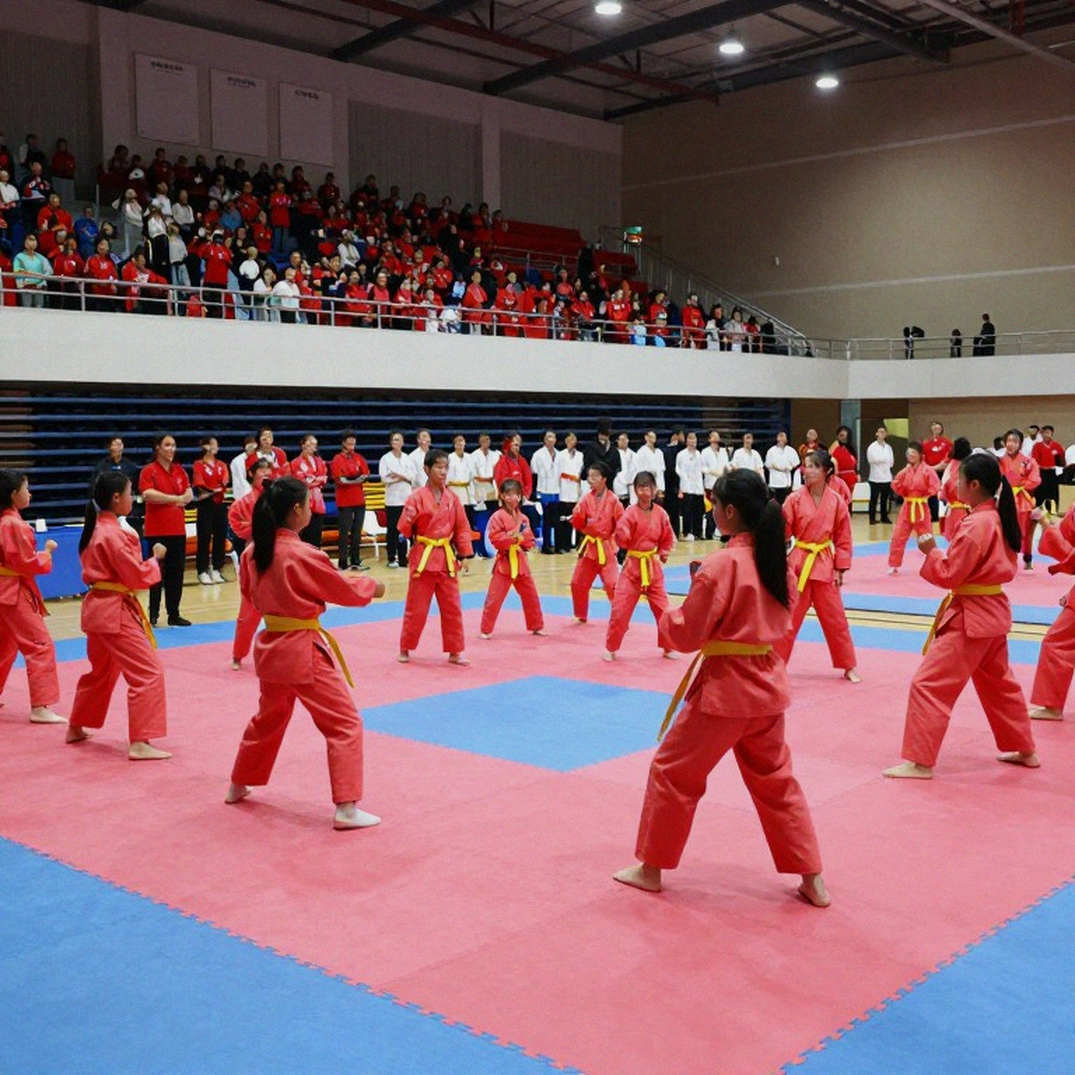
Three athletes step onto the mat. In front of them, no one.
That is the first thing I want readers to remember when talking about Vietnam's women's team kata gold at Asiad 20. No opponent standing a meter and a half away waiting for the signal. No holds, no strikes to a target, no timed scoring rounds. Just three people, one form, and five judges seated above with the power to decide everything.
In the final, when the last flag went up, the number that appeared was 5-0. Five out of five. Not a razor-thin win, not a decision requiring video assistance to settle. Five judges, five flags, one direction. Yet some outlets call it a "convincing victory" — a fine, tidy phrase with no data behind it at all.
For years I have sat in press rooms and on terraces, hearing people describe combat results with words like "better", "stronger", "more deserving". Every time, I ask myself: better by which criterion, stronger measured with which ruler. That is why I chose my current path — explaining a decision through rules, through consistency of application, not through the emotion of a crowd.
To read this medal correctly, it must be placed in the right category of competition. Karate has two entirely different branches: kumite and kata. Kumite is contest — two people, contact, points for strikes. Kata is performance — a pre-choreographed form scored by judges. These two branches differ not only in rules but in the very logic that decides the outcome.
The oddity is this: team kata at Asiad 20 was run in an elimination-bracket format, exactly like kumite. Teams did not all perform once for the panel to score and rank, but entered a direct knockout draw. One team meets another, the winner advances, the loser stops. This is the single most important structural fact for understanding why this gold is sturdier than it looks.
In purely performance disciplines, an athlete only needs to deliver their best once. In a bracket, Vietnam's team had to perform at peak three times on the same competition day: quarterfinal, semifinal, and final. Peak excellence is not enough; repeatability is required. This is a factor most result summaries ignore.
The deeper context lies in history. Three years earlier, at Asiad 19, Vietnam had won women's team kata gold. But then the field had only four nations. At Asiad 20, the number rose to eight, with new challengers like Iran, Chinese Taipei and Macau. A repeat gold against a field twice as deep is a far stronger signal than a repeat against the old field.
On personnel, the squad changed substantially. Where Asiad 19 had other faces, at Asiad 20 the three on the mat were Nguyen Ngoc Tram, Bui Ngoc Nhi and Hoang Thi Thu Uyen. Two of the three spots changed from the previous cycle. Nguyen Ngoc Tram is the only survivor, having gone from the youngest member of that earlier team to the eldest of this one.
Ages speak volumes. Nguyen Ngoc Tram is 24, entering her prime. Bui Ngoc Nhi is 19 and Hoang Thi Thu Uyen 20, still on the way up. In a discipline scored on technique and experience like kata, peak years tend to arrive later than in contest. That means the two youngest members may still be below their true ceiling.
Alongside the athlete churn, the coaching staff changed. The team's former coach, Nguyen Hoang Ngan, was known to insiders as a "kata queen". The current coach is barely mentioned in the coverage of this gold. That is a notable information gap, because in team kata it is the coach who transmits technical standards and uniformity.
One thing must be made clear about scoring, because without it every later analysis loses its foundation. Kata is subjectively judged. There is no time, no points per strike, no objective metric. The result comes from a panel, usually five people, each ranking one team above the other. The team taking a majority wins. That is why we see "5-0" results rather than point totals.
This subjectivity is not a flaw to be erased; it is the nature of a performance discipline. What matters is that it creates a specific kind of risk: the outcome depends on the panel's leaning, and in a worst case, on factors beyond technical merit. In kumite one can argue about a strike; in kata the argument always circles the question "which team performed better", which has no absolute answer.
I do not trust my eyes; I trust the repeated rhythms on the floor. A single performance can impress in the moment, but only patterns repeated across rounds reveal true capability. That is the criterion I apply to this Vietnamese medal.
In the quarterfinal, Vietnam met Nepal and won 5-0. All five judges ranked Vietnam above the opponent. No dissenting flag. Technically it was a warm-up round, but it set a pattern: the team entered with standards already complete and no serious execution error.
In the semifinal, the opponent was Chinese Taipei, a nation with a karate medal tradition. The flag result was again 5-0, but this is the round worth discussing. According to the available data on scoring margins, the gap in the semifinal was narrower than in the final, ranging from 0.3 to 0.4 points per judge. The team still won every card, but its dominance was not as crushing as in the next match.
This is a detail result summaries flatten away. The same 5-0 flag result, yet two matches can have entirely different degrees of separation. Reading the flags without reading the margins is reading half the story. I stress this because it is what separates a solid win from an overwhelming one.
In the final, the opponent was Iran, who had reached the last match by eliminating Thailand and the Philippines. Judged by their path, Iran was a genuinely weighty opponent, having beaten karate nations that are not small. Yet in the final they were ranked below Vietnam on every card, with margins of 0.3 to 0.7 points per judge. The gap was wider than the semifinal.
This pattern deserves pause. A 5-0 result with consistent margins across all judges suggests a gap in execution quality, not a borderline preference. When a team is only slightly ahead, panels tend to split their flags. When all five agree, and agree with a relatively clear margin, the story usually lies in performance quality rather than bias.
Now the most decisive factor in team kata: uniformity. In individual kata, an athlete only needs high technical standards and good fitness. But in team kata, three people must move as one. One person off-rhythm, one lifting a knee half a beat early, one rotating the hip a quarter-second late, any of these is enough to break the scoring structure.
Uniformity is a time-dependent skill. It is built through thousands of repetitions, through three bodies learning to breathe in the same rhythm, to stop together, to explode together. A young team that has just won gold may still be below its own ceiling in synchronization. This matters when assessing their potential: the true peak may not have arrived.
One more variable: kata selection. In kata, a team must not only perform perfectly but also choose what to perform. Some forms suit a team's strengths better than others. Some are favored by a panel's leaning. Choosing the right form for the right round, while avoiding one too many repetitions, is a silent tactical decision. Unfortunately, most reports do not record which kata was performed in which round. This gap makes reading the match harder.
One question remains unanswered: whether the application-demonstration segment was required in the medal rounds. Historically, under World Karate Federation systems, team kata sometimes required a segment demonstrating the meaning of the form. If it was present at Asiad 20, the weighting for synchronization and interpretation would rise considerably. The available data does not confirm this.
On physical endurance, the bracket format creates a demand that single-run disciplines do not. Three performances in a day, each involving energy-costly movements like deep stances, jumps, turns and sudden stops. This kind of motion loads the knees, hips and lumbar spine. No one strikes your head in kata, but your body still endures quietly.
This is where kata differs from the popular image of martial arts. I once analyzed Gamba Osaka's collapse in the domestic league in 2026, building a framework with 14 variables including expected-goal metrics, average running distance and frequency of passes into the final third. I learned that a crisis never arrives without signs; it arrives only to those who do not read the signs.
Collapse does not come from a single defeat, but from cracks no one wants to examine. In kata, the crack usually does not appear in one failed performance. It appears in fatigue accumulated across three rounds. A team excellent in the quarterfinal can decline in the final if the fitness base is not durable. Vietnam, holding its winning margin through the last match, showed its fitness base held across the whole day. That is an important technical signal.
But I want to return to the word "convincing".
Reading coverage, I often find phrases asserting an outcome without reasons. "Convincing win" is one. In reality, the judge data only partly supports the claim. In the final, the margin was wider than the semifinal, and that can justify such a label. But in the semifinal, the margin was narrower, and calling both equally "convincing" flattens the difference in match control.
This is where what I call the referee's eye applies. In 2026, at the World Cup final tournament in Qatar, I watched the semifinal between Argentina and Croatia and saw a controversial penalty involving Julian Alvarez. Instead of joining the media debate, I contacted a retired FIFA referee in Osaka and interviewed him over three consecutive days about the decision process from a rules standpoint. What I gained was not a verdict on right or wrong, but a set of criteria for reading body movement and assessing intent.
The lesson for kata is this: when a discipline is decided by a panel, we must read the result as a relative signal, not an absolute truth. The gold medal is real, undeniable. But the margin is a signal about quality distance, not a declaration of permanent superiority.
I also want to note a paradox few observe. As the field widened from four to eight nations, the medal's value rose, but so did the difficulty of defending it. Iran reached the final by eliminating Thailand and the Philippines. Chinese Taipei is a karate nation with a medal tradition. Macau joined the list. These names are no longer filler; they are organized opponents with development systems.
This leads to a psychological warning. For a squad with two members aged 19 and 20 who just won a continental gold, the pressure for the next cycle will be far greater than this one. The expectation to defend, to win a third straight, to build a dynasty. That pressure does not appear in reports, but it is real inside young athletes' minds.
On the competitive side, one must face a fact about scale. Eight teams is a bigger field than four, but still a small field beside global karate championships. The absence of kata powers like Japan, if the available data is accurate, lowers the absolute competitive ceiling of the medal. This is not a denial of the achievement, but a note on context.
Discipline is not prohibition; it is clarity to the point of cruelty. In analysis, cruel clarity means saying what people do not want to hear. Saying the gold is real, while saying the database for measuring its competitive depth remains thin. Saying the team deserved to win, while saying the degree of separation is only partly confirmed by the numbers.
One point on source quality must be raised. Most information in the summary I read cites no source, and the scoring data only cites "competition judges" generically. In my profession, that is a gap to be addressed before turning it into fact. Specific score values should be treated as data pending verification, not settled truth.
I have a principle born of a personal mistake. In 2026, aged 25, during a World Cup qualifier between Japan and Australia, I mispronounced a midfielder's name three times in a row. The online audience attacked immediately. I did not respond; instead I spent four weeks reviewing all his match footage, noting pronunciation by region. My mistake of 2026 remains the yardstick for every report I write today.
Since then I have built a personal database of athlete-name spelling, with source annotations, always cross-checking three sources before publication. One misspelled name is enough to tell me I have not been strict enough with myself. That is why, in the case of Vietnam's women's kata team, I want to flag a detail needing verification: the Asiad 19 roster included a member with the middle name "Thu Uyen", and the Asiad 20 roster also includes a member with the middle name "Thu Uyen". Most likely these are two different people, but it could also be a transcription error. The breakdown of who is a newcomer needs independent confirmation.
On economics, this is a field where market numbers do not exist. Amateur kata has no pay-per-view model, no per-match purses, no transfers, no free agency. Athletes represent national federations. Their commercial value is almost entirely decoupled from competitive value. Financial reward, if any, comes from state budgets and medal-bonus schemes, not from a ticketed arena.
This means the medal's value sits with the nation, not the individual. It is an index of the development system's capability, not a commercial product. Reading a kata report, one must remember we are talking about a state-funded sport, operating on a four-year cycle, peaking at the continental stage.
One reality about karate's Olympic status must be noted. After a one-off appearance at the Tokyo Games, karate was dropped from the Paris 2026 and Los Angeles 2028 programs. This further elevates the Asian Games for kata athletes. Without an Olympics, the continental stage becomes the highest platform. A gold there means something different from a gold at a Games with all powers present.
On health risk, kata has a major structural advantage: it is non-contact. No cumulative brain injury, no risk of being knocked down by a strike, no brutal weight cuts. The most serious risks of professional martial arts are largely absent. What remains is overuse injury, real but moderate.
The bigger risk, off the mat, is career security. In a non-commercial amateur discipline, a career-ending injury or a slump can translate directly into financial precarity. There is no transfer market to cushion it. No personal sponsorship contract to compensate. This is the kind of risk gold-medal reports rarely mention.
I want to return once more to the Tomiyasu story, because it shaped how I choose subjects. In 2026, following the Euros and the Tokyo Olympics, I spent two weeks analyzing the tackling data and tactical fouls of a little-noticed defender instead of writing about the attacking stars everyone wrote about. His duel win rate reached 78 percent, 23 percentage points above the tournament average. I then wrote a long analysis of him as a mobile shield.
The lesson here: real value often lies in the factors few examine. In team kata, real value lies in synchronization, repeatability, kata selection, not in the dazzling clips cut for social media. Readers deserve to hear about those factors, not only about a gold medal.
So what does Vietnam's women's team kata gold at Asiad 20 mean?
It is a sporting achievement firmly established by judge data. Winning every card across all three rounds, from quarterfinal to final, is a consistent result, not a lucky split decision. Against Nepal, Chinese Taipei and Iran, all five judges ranked Vietnam higher.
It is also a signal of the development system's depth. Replacing two of three squad members and changing the coach while still holding gold shows this is not a single individual's achievement but the output of a reproducible mechanism.
And it is a signal of potential. With a squad aged 24, 19 and 20, the core structure can persist across at least one or two more Games cycles. This is a favorable position for a long-term ambition, not a one-off peak.
But one aspect the celebratory coverage usually misses. The field is deepening. Iran, Chinese Taipei and Macau are growing. Assuming the next gold will arrive automatically is over-optimistic. A dynasty is not built by assuming it will continue; it is built by preparing for the possibility it can be stopped.
What I want to leave readers is not a conclusion but a way of looking. Reading about a gold in a panel-judged discipline, read both the number and the margin. Look at the number of participating nations, not just the ranking. Ask who the coach is, who transmits technical standards to the next generation. Remember that a continental gold in a non-commercial sport carries more political and social meaning than economic meaning.
Three athletes step onto the mat. In front of them, no one. Behind them is a system: judges, federation, coaches, thousands of repeated practice sessions so three bodies move as one. The gold is the endpoint of a process, and also the start of an unanswered question: can this uniformity be reproduced as the field keeps widening and as the youngest members of the team are no longer the youngest.


Cầu thủ liên quan
Bài đề xuất
Five Flags and a Gold Medal: Reading Vietnam's Women's Team Kata at Asiad 20 Through a Referee's Eye2026-09-23
Incomplete Analysis Data: Cannot Create 1290 Word Sports Article2026-09-09
The Blank Cell in a Thai Combat Sports Reporter's Notebook2026-09-16
Summer Transfer Window: Don't Read the Price, Count the Breathing from Training Ground2026-09-09
Vietnamese Karate Wins ASIAD Gold: A Leap From 25th to Asia's Top 122026-09-23
Synchronized Forms: Decoding Vietnam's Poomsae Gold at Chuncheon 20262026-09-19